Middle school marks a pivotal time for vocabulary development, tying word knowledge to reading comprehension, writing prowess, and overall academic confidence. The following selections deliver structured practice, engaging activities, and practical strategies to help students unlock the meanings of roots, prefixes, suffixes, and high-utility words. This guide highlights five well-regarded options that align with common core standards and classroom needs, spanning root words, ready-to-reproduce packets, spelling and vocabulary skills, and Spanish language supports.
| Product | Brand | Format | Key Benefit |
|---|---|---|---|
| Vocabulary Packets: Greek & Latin Roots | Scholastic | Practice Packets | 40 key roots to unlock many words |
| 240 Vocabulary Words Kids Need to Know: Grade 6 | Scholastic | Reproducible Packets | Structured practice to build context and usage |
| Spectrum Spelling Workbook Grade 6 | Spectrum | Spelling & Grammar Workbook | Spelling patterns aligned to standards |
| Carson Dellosa Skills for Success Spanish Workbook | Carson Dellosa Education | Spanish Language Skills | Vocabulary and grammar in Spanish |
| WORD TEASERS Middle School | WORD TEASERS | Vocabulary Flash Cards/Conversation Cards | Engaging prompts to build usage and discussion |
Vocabulary Packets: Greek & Latin Roots

Scholastic’s Vocabulary Packets focus on Greek and Latin roots as a foundational approach to vocabulary growth. Each packet introduces key roots and helps students connect roots to dozens of words they encounter in reading and content-area texts. The included activities incorporate crossword puzzles and word searches, making practice interactive rather than repetitive. By building a robust understanding of root words, students can infer meanings of unfamiliar terms across subjects, supporting metacognitive strategies for independent word-learning and reading comprehension.
Teaching implications: Use these packets as a weekly routine module to reinforce root-based decoding. Pair with quick exit tickets to assess mastery and adjust instruction. The structure is conducive to small-group work or individualized practice, enabling teachers to target students who benefit most from explicit root word instruction.
240 Vocabulary Words Kids Need to Know: Grade 6

Scholastic’s 240 Vocabulary Words for Grade 6 presents 24 ready-to-reproduce packets designed to build vocabulary within meaningful contexts. The program emphasizes research-based activities to sustain engagement and motivation. Each packet builds on prior knowledge, guiding learners through context-rich examples that illustrate word meaning, usage, and nuance. The approach supports differentiated instruction by providing clear, self-contained activities that teachers can assign as homework or classwork.
Instructional value: The packets enable consistent practice across a unit, helping students internalize word meanings, usage patterns, and synonyms/antonyms. The reproducible format is particularly useful for teachers seeking scalable materials for whole-class and small-group rotations.
Spectrum Spelling Workbook Grade 6

Spectrum’s Spelling Workbook for Grade 6 blends spelling practice with word meaning and context. This resource aligns with state standards and reinforces spelling patterns, morphology, and grammar skills. The workbook emphasizes deliberate practice in strategies that connect spelling with meaning, which helps students improve reading fluency and effective writing. For teachers, it offers structured lessons that can be integrated into daily warm-ups, literacy centers, or independent practice stations.
Why it works: By linking spelling rules to semantic understanding, students gain insight into word construction and phonetic patterns. The workbook’s clear progression supports gradual mastery, which is ideal for students who benefit from explicit, scaffolded instruction in word structure and usage.
Carson Dellosa Skills for Success Spanish Workbook
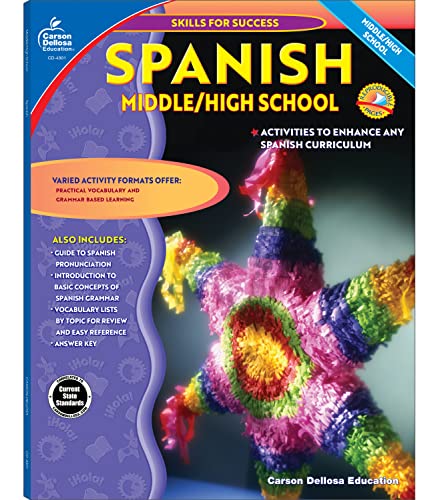
Carson Dellosa’s Skills for Success Spanish Workbook targets middle school learners with activities designed to build vocabulary, grammar, and sentence construction in Spanish. Whether used alongside a formal Spanish program or as a standalone resource, the workbook emphasizes everyday vocabulary and practical usage. It includes reproducible storybooks, a pronunciation key, and an answer key, making it a practical choice for both classroom and homeschool settings. The 128-page format supports extended practice without overwhelming students with dense text.
Considerations: This workbook supports bilingual or language-transition curricula and can be a valuable tool for English learners seeking to reinforce language skills in another language. It complements English vocabulary work by offering parallel skill development and reinforcing grammar in context.
WORD TEASERS Middle School
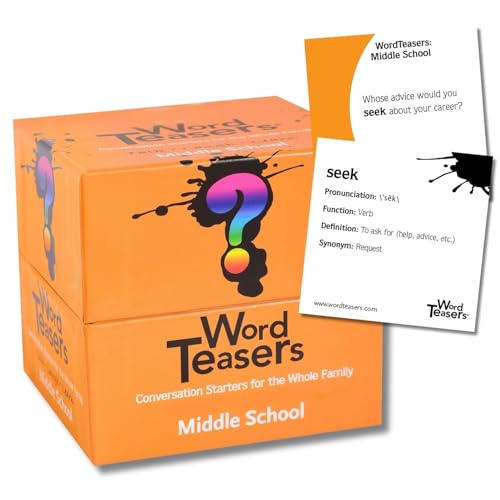
WORD TEASERS offers a practical vocabulary game that blends flash cards with conversation prompts. The 150 cards introduce middle school vocabulary in a question-and-answer format, encouraging discussion and usage. The back of each card includes definitions, pronunciation, and word function, turning a simple deck into a dynamic learning tool. This resource supports informal assessment through oral language practice and peer-to-peer discourse, helping students apply new terms in authentic contexts rather than memorizing definitions alone.
Usage suggestions: Use this kit as a warm-up activity in class, a station for language centers, or a tutor-led review. It fosters active participation and helps students articulate word meanings clearly, supporting both reading comprehension and writing fluency.
Carson Dellosa Skill Builders Grades 6-8 Spanish Workbook

Carson Dellosa’s Skill Builders for grades 6-8 focus on vocabulary, sight words, and phrases within a Spanish language framework. The workbook is designed for both classroom use and homeschooling, offering a variety of activities that provide practice with national standards-aligned content. Students tackle passages and exercises designed to build basic word recognition and language comprehension, helping learners progress toward more complex linguistic tasks with confidence.
Buying Guide: Key Purchase Considerations and Comparisons
When selecting vocabulary-focused resources for middle school, consider the following dimensions to balance scope, pedagogy, and practicality:
- Target skills: Determine whether you need root-word knowledge, general vocabulary, spelling support, or bilingual language practice. Choose materials that align with your students’ needs and curriculum goals.
- Format and pacing: Reproducible packets work well for differentiated instruction, while structured workbooks suit daily routines. Decide if you want ready-to-use activities or more flexible formats.
- Engagement and activities: Look for a mix of activities—puzzles, games, flash cards, and context-based exercises. Engaging formats support retention and motivation.
- Assessment potential: Check whether resources include answer keys, rubrics, or quick formative checks that help monitor progress and inform instruction.
- Accessibility and inclusivity: Consider language supports for English learners and materials that provide clear explanations, pronunciation guides, and examples in context.
- Standards alignment: Confirm alignment with state or national standards relevant to your district to facilitate smoother integration into the curriculum.
- Teacher supports: Resources with teacher guides, reproducible worksheets, and suggested activities can save planning time and support classroom management.
- Durability and format: If materials will be used repeatedly, consider print quality and readability, as well as digital equivalents or additional online resources if available.
Comparative perspective:
- Root-focused programs (like the Greek and Latin roots packets) are highly effective for decoding and inference across disciplines, making them a solid core for vocabulary growth.
- Reproducible practice packs provide scalable practice that supports both whole-class instruction and targeted interventions, offering flexibility for varied classroom needs.
- Spelling-centered workbooks reinforce not only word form but also meaning and usage, contributing to reading fluency and writing accuracy.
- Supplemental tools, such as flash-card games, promote active usage and discussion, helping students internalize vocabulary through context and social interaction.
- Spanish-language resources address bilingual learners and can bolster cognitive benefits by integrating cross-language word knowledge and structure.