Expanding a child’s vocabulary is a foundation for reading comprehension, writing clarity, and everyday communication. The following hand-picked vocabulary books for kids offer structured practice, engaging activities, and teacher- or parent-friendly guidance. Each title below is designed to fit different grade levels while building word knowledge in a fun, age-appropriate way.
The table below summarizes five top options, highlighting grade focus, formats, and what makes each resource effective. Use this at-a-glance guide to compare approaches and choose the best fit for your child’s needs.
- 240 Vocabulary Words Kids Need to Know, Grade 4 — Scholastic
- 240 Vocabulary Words Kids Need to Know, Grade 2 — Scholastic
- 240 Vocabulary Words Kids Need to Know, Grade 6 — Scholastic
- Daily Word Ladders: Grades 4-6 — Scholastic
- Spectrum Grade 4 Vocabulary Workbook — Spectrum
240 Vocabulary Words Kids Need to Know, Grade 4: 24 Ready-to-Reproduce Packets

Scholastic’s Grade 4 vocabulary resource organizes learning around 24 reproducible packets, each designed to reinforce essential word knowledge through context and practice. The format supports teachers and parents with ready-to-use activities that keep students engaged. The program emphasizes building on prior knowledge, ensuring each new word connects to previous learning for stronger understanding.
Key features include research-based activities, clear context for all skills, and a focus on motivating learners through structured repetition. This approach helps students internalize word meanings, usage, and nuance—critical steps toward more fluent reading and writing. The packets are designed to be flexible for classroom or home use, with reproducible materials that streamline lesson planning.
240 Vocabulary Words Kids Need to Know, Grade 2: 24 Ready-to-Reproduce Packets

Grade 2 focuses on foundational word knowledge with the same reproducible packet structure. This resource helps younger readers build confidence as they encounter and practice core vocabulary in varied contexts. The designed progression supports early literacy by linking new words to familiar concepts and prior learning experiences.
With clearly presented activities and engaging prompts, students can demonstrate progress in vocabulary, while teachers observe growth through consistent, repeatable tasks. The emphasis remains on practical usage and meaningful context to anchor new terms in everyday language.
240 Vocabulary Words Kids Need to Know, Grade 6: 24 Ready-To-Reproduce Packets

For upper elementary learners, this grade-6 edition extends vocabulary knowledge with a robust set of 24 reproducible packets. The program aims to deepen understanding by presenting words in multiple contexts and linking them to prior knowledge. The structured packets support independent work as well as guided instruction, aiding classroom management and student accountability.
Students encounter high-frequency and challenging terms, with activities designed to promote deeper comprehension and flexible usage. The approach helps learners extend their reading comprehension and expressive abilities across subjects, not just in language arts.
Daily Word Ladders: Grades 4-6: 100 Reproducible Word Study Lessons

Daily Word Ladders provides a game-like approach to word study, featuring 100 reproducible lessons that boost reading, vocabulary, spelling, and phonics. The ladder format invites students to read clues, modify letters, and create new words in a stepwise challenge. This interactive methodology supports independent work and cooperative activities, making vocabulary practice dynamic and motivating.
The series emphasizes incremental skill-building, encouraging persistence as learners climb through progressively more complex word ladders. Its design supports varied paces, allowing quick wins for struggling readers and stretch goals for advanced learners, all within familiar Scholastic-style structure.
Spectrum Grade 4 Vocabulary Workbook
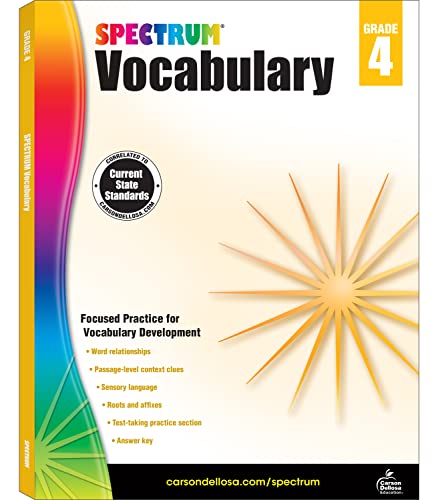
Spectrum’s Grade 4 Vocabulary Workbook delivers focused practice around word relationships, context clues, sensory language, roots, and affixes. The workbook is designed to complement science and social studies by reinforcing vocabulary in context, while also supporting reading comprehension development. The materials are suitable for classroom use or homeschool settings.
This resource emphasizes repeated exposure to words and nuanced meanings, helping learners connect vocabulary with reading passages and real-world usage. Readers can expect structured activities that promote better understanding of how words function within sentences and larger texts.
240 Vocabulary Words Kids Need to Know, Grade 1: 24 Ready-to-Reproduce Packets

Grade 1 introduces foundational word knowledge with the familiar 24 reproducible packets. This early-start approach supports emergent readers by providing engaging practice that reinforces essential vocabulary in accessible contexts. The packets lay groundwork for later grades, emphasizing words children are likely to encounter in school and everyday life.
Early practice focuses on recognition, usage, and simple sentence construction, helping children develop confidence as their lexicon grows. The program’s consistent format across grades also helps caregivers and teachers track progress over time.
100 Words Kids Need to Read by 1st Grade

This resource centers on 100 essential sight words that first graders should recognize to support fluent reading. It includes fill-in-the-blank stories, sentences, word riddles, games, and puzzles to reinforce the target words. The emphasis is on quick recognition and automatic recall to accelerate early reading progress.
By combining word practice with engaging activities, the book aims to foster both accuracy and fluency. It can serve as a practical daily practice tool for busy households and classroom routines alike.
Spectrum 5th Grade Vocabulary Workbook

The Spectrum 5th Grade Vocabulary Workbook targets fifth-grade language development with focus on analogies, multiple-meaning words, context clues, and roots and affixes. The structured exercises help students apply vocabulary to reading comprehension, writing, and tests. The workbook is designed for both classroom and homeschool use.
Key strengths include targeted practice on word relationships and domain-specific vocabulary, ensuring students can navigate more complex texts. The program aligns with typical curricula while offering flexible pacing for varied learner needs.
Buying Guide: Key Purchase Considerations And Comparisons
- Grade alignment: Choose volumes that match the student’s current grade or reading level to ensure appropriate challenge without frustration.
- Format and accessibility: Reproducible packets are great for teachers and parents who want ready-to-use materials; workbooks suit daily independent practice.
- Contextual learning: Look for resources that emphasize context, word relationships, and usage within passages to build durable understanding.
- Engagement strategies: Activities that combine color, games, or ladder-style challenges can sustain motivation and counteract monotony.
- Assessment potential: Materials with built-in progress checks or clear practice milestones help track growth over time.
- Content breadth: Consider whether you need focus on grade-level vocabulary, or broader word knowledge spanning multiple grades.
- Supplemental value: Some titles emphasize spelling, phonics, or reading comprehension alongside vocabulary, offering a holistic approach.
Across these selections, the common objective is to build a practical and durable vocabulary that supports reading comprehension, writing clarity, and confident communication. When choosing, prioritize how a book’s structure—packets, ladders, or workbooks—fits the learner’s routine and preferred learning style. The right match can foster steady progress, sustained engagement, and measurable word growth in American classrooms and homes alike.