Exploring social skills resources can help children with autism build essential communication abilities, emotional understanding, and peer interaction. The following five products, selected for their focus on social scenarios, emotions, and practical activities, offer interactive formats and age-appropriate guidance. This article summarizes each item and provides considerations to help families choose the right fit.
| Product | Brand | Format | Key Benefit |
|---|---|---|---|
| Picture Book and Emotion Cards, WH Question Flipbook | SPARK INNOVATIONS | Picture Cards, Flipbook | WH questions, storytelling, emotional recognition |
| The Social Skills Picture Book | Future Horizons | Printed Picture Book | Teaching play, emotion, and communication |
| Autism & Prosperity Kids Emotions & Social Life Skills Bundle | Autism & Prosperity | Emotions & Social Skills Materials | Visual, concise social skills and emotion aids |
| Maitys Feelings and Emotions Book | Maitys | Flip Book with Mood Regulation | Interactive mood recognition and regulation |
| Big Heart Toys Leo Starts a Conversation Sound Book | Big Heart Toys | Sound book with interactive buttons | Multi-sensory social cues and communication practice |
The following sections provide concise overviews of each item, highlighting how they support social skills development and emotion understanding for children on the autism spectrum. Settings include therapy sessions, classroom use, homeschooling, and everyday family interactions.
Picture Book and Emotion Cards, WH Question Flipbook

The SPARK INNOVATIONS set blends picture storytelling with emotion recognition and WH-question prompts. The book-style pages and associated cards support language development, storytelling, and problem-solving. Children explore everyday scenes, identify emotions, and practice expressing feelings with guided prompts that encourage critical thinking and self-esteem. This bundle is particularly suitable for homeschoolers and therapists seeking a structured, visual approach to social skills. The blend of scenarios engages learners in identifying feelings, predicting outcomes, and building coping strategies that align with social expectations.
The Social Skills Picture Book: Teaching play, emotion, and communication to children with autism

Future Horizons presents a classic resource focused on practical social skills through storytelling, pictures, and structured activities. While described as a used book in good condition, the content remains a staple for teaching play, emotion recognition, and communication strategies to children with autism. The book’s approachable format makes it accessible for teachers, clinicians, and parents seeking step-by-step scenarios and guided discussions that translate into real-world interactions with peers.
Autism & Prosperity Kids Emotions & Social Life Skills Bundle
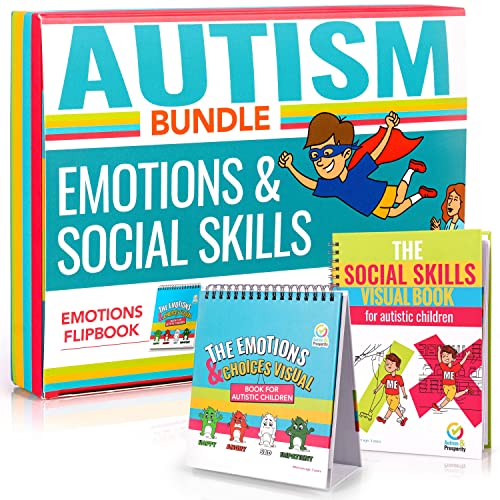
This bundle emphasizes ultra-visual, concise tools designed to support social interactions and emotion understanding. It targets common ASD challenges like initiating conversations, interpreting others’ feelings, and managing social settings. The materials aim to reduce challenging behaviors by providing clear cues and step-by-step exercises. Parents and educators may find it helpful for structured practice, small-group activities, and home routines that reinforce positive social responses in varied contexts.
Maitys Feelings and Emotions Book for Kids

The Maitys flip book offers an interactive approach to mood recognition and social skills development. With laminated tabs and kid-friendly visuals, it supports quick mood identification and positive responses. Its compact size makes it practical for car rides, calm-down corners, and on-the-go learning. Educators can leverage the stand-up design for easy tabletop display, promoting ongoing engagement as children practice identifying emotions, choosing coping strategies, and modeling appropriate social behaviors in daily life.
Big Heart Toys Leo Starts a Conversation Sound Book

This interactive sound book supports neurodivergent learners through built-in audio and tactile elements. Real-life scenarios encourage engagement with big emotions and social cues, with a focus on communication, empathy, and self-expression. The book’s therapist-informed design and guided questions provide structured opportunities for decoding body language, responding to social situations, and practicing conversation turns. It’s a versatile resource for therapy sessions, classroom activities, and home use, offering multisensory learning that can enhance language development and social understanding.
Buying Guide: Key Purchase Considerations
- Content focus: Consider whether you need emotion recognition, language-building prompts, or concrete social scenario practice. Some titles emphasize storytelling, others emphasize interactive tools or multi-sensory engagement.
- Format and accessibility: Flip books and sound books offer hands-on interaction, while traditional picture books suit guided reading and discussion. For travel and on-the-go learning, compact and laminated formats are advantageous.
- Age and developmental level: Check recommended age ranges and complexity of prompts. Some resources are more visual and simpler, while others provide nuanced guidance for older children.
- Therapy alignment: If using with a therapist, verify whether the tools align with evidence-based strategies for social skills training and emotion regulation.
- Durability and setup: Laminated pages, sturdy bindings, and stand-up designs support repeated use in classrooms, homes, and therapy settings. Consider how easy it is to reset activities for multiple sessions.
- Multi-sensory options: Sound books and tactile features can enhance engagement for children who respond well to multisensory input, facilitating language and social cue processing.
- Cost and longevity: Look for resources that offer long-term usefulness across ages or skill levels to maximize value as a child grows.
When selecting a social skills resource, align the choice with your child’s goals, whether that is improving conversational turn-taking, recognizing emotions, or navigating peer interactions in school or community settings. Combining several tools can create a comprehensive approach that covers language development, emotional understanding, and practical social behavior in daily life.