Creating a personal cookbook can simplify meal planning, preserve family favorites, and encourage culinary creativity. The following five blank recipe books are designed to help you organize ingredients, steps, and notes in a durable, kitchen-friendly format. Each option offers distinct layouts, bindings, and space to accommodate a growing collection of family recipes and personal twists. Use this guide to compare features and choose the best fit for your cooking style and storage needs.
| Product | Brand | Pages/Space | Notable Advantage |
|---|---|---|---|
| LuBudingJoy Blank Recipe Notebook | LuBudingJoy | 120 pages + 4 conversion charts | Back pocket and colorful category stickers |
| Elegant Recipe Book for 100+ Meals | ZICOTO | 106 blank pages | Waterproof hardcover; one-recipe-per-page layout |
| Perfect Blank Recipe Book | Buluer | 144 pages | Ingredient and oven conversion charts |
| Recipe Book to Write in Your Own Recipes (7″ x 10″) | Pixie Mecca | 120 pages + folder features | Includes pocket page and dividers |
| Recipe Book to Write in Your Own Recipes (9.6″ x 12.5″) | SOLIGT | 240 recipes capacity | Removable journal with dividers and tabs |
LuBudingJoy Blank Recipe Notebook

The LuBudingJoy blank notebook is an 8.5″ x 11″ spiral-bound recipe book designed to hold up to 120 blank pages for writing personal recipes. It includes a sheet of colorful category stickers to organize dishes by type and an index-friendly content layout with conversion charts to help with common kitchen measurements. A back pocket provides space for loose notes or clippings. The premium 100gsm paper reduces ink bleed, and the waterproof hardcover protects recipes from spills, making it a practical kitchen companion for home cooks and aspiring chefs.
Elegant Recipe Book for 100+ Meals

From ZICOTO, this compact 8.27 x 10.04 x 0.66 inch hardcover notebook is built to withstand kitchen use and keeps recipes organized with a one-recipe-per-page layout. It emphasizes a durable kitchen-proof design and a modern aesthetic suitable for countertop display. With 106 blank pages, it offers ample space for ingredients, steps, notes, and special tips, supporting a tidy, intuitive cookbook where you can quickly locate favorites during preparation.
Perfect Blank Recipe Book

The Perfect Blank Recipe Book from Buluer offers a practical 144-page layout in an 8.5 by 5.5 inch format. It includes an ingredient conversion chart, an oven conversion chart, and a straightforward layout for recording time, ingredients, directions, notes, and dietary restrictions. The design supports flexible handwriting, enabling you to tailor recipes to taste while keeping a clean, organized record of your culinary experiments.
Recipe Book To Write In Your Own Recipes (7×10)

Pixie Mecca’s 7″ x 10″ hardcover blank cookbook provides 120 recipe pages plus a pocket page and 15 divider labels to categorize dishes. It includes a kitchen conversions page for quick reference and a high-quality paper stock designed to resist curling and ink bleed. The book’s layout is simple and functional, allowing handwritten entries for a personalized home cookbook and easy organization by category.
Recipe Book to Write in Your Own Recipes (9.6×12.5)
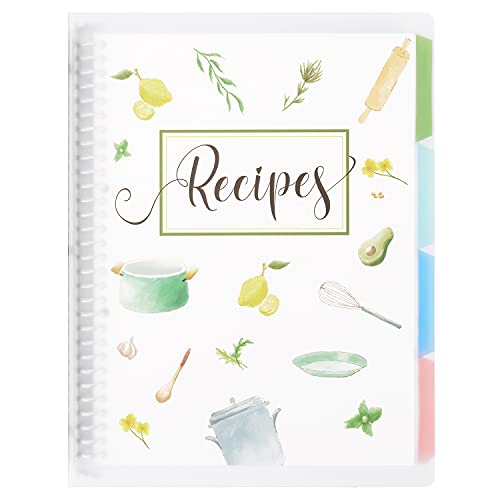
SOLIGT offers a larger 9.6″ x 12.5″ personal blank recipe notebook with space for up to 240 recipes. It includes a removable binder with eight dividers and 24 tabs, plus a four-sided layout for 300 fields across double-sided contents. A kitchen conversion magnet is included, and the ample pages are designed for extensive family recipe collections, expanding as needed while preserving structure with dividers and tabs.
Buying Guide
- Size and layout: Choose between compact or large formats. Larger books provide more space for long recipes or detailed notes, while compact sizes are easier to store and handle for quick references.
- Binding and durability: Spiral, hardcover, and binder-style bindings affect how flat the book lays on the counter and how well it withstands kitchen conditions. Waterproof covers and quality paper reduce bleed and wear from spills.
- Page structure: Consider whether you want one recipe per page, multiple recipes per page, or a modular system with dividers and tabs. Index pages, conversion charts, and category stickers can improve organization.
- Organization tools: Pockets, dividers, labels, and back pockets help store recipe cards, clippings, or supplementary notes. Labels enable quick grouping by dish type, occasion, or dietary needs.
- Paper quality and bleed resistance: 100gsm or higher paper minimizes ink show-through and feathering. Look for fountain-pen friendly if you prefer broad writing tools.
- Expansion potential: If you anticipate adding many recipes over time, choose a system with removable pages, extra dividers, or a binder with capacity for expansion.
- Special features: Kitchen conversion charts, magnets, or category stickers can accelerate cooking and keep essential measurements handy.
- Price and usability: Compare value based on page count, features, and durability. A well-organized notebook can save time and preserve recipes for generations.
Each option above is designed to help you create a personalized, durable, and organized cookbook. When selecting, match the book’s size, binding, and layout to your cooking habits, the types of recipes you collect, and how you prefer to categorize and access information while cooking.