For American readers beginning their journey with Portuguese, a mix of interactive cards, kid-focused books, and practical phrase guides can accelerate learning. This article highlights five beginner-friendly options, balancing pronunciation, vocabulary, and cultural exposure. Each pick is designed to be portable, engaging, and easy to integrate into daily practice.
| Product | Why It Fits Beginners |
|---|---|
| Portuguese Flash Cards – Learn Portuguese Language Vocabulary Words and Phrases | Compact, portable learning with phonetic help and English translations |
| I Love To Sing In Portuguese: Brazilian Nursery Rhymes | Fun for kids and adults; rhythmic exposure to Brazilian Portuguese |
| Brazilian Portuguese Flash Cards with Audio – 75 Conversational Phrases | Audio support and practical phrases for real conversations |
| Portuguese English Sound Book | Interactive, bilingual approach with sounds and activities |
| The Everything Learning Brazilian Portuguese Book | Structured guide to speaking, writing, and understanding basics |
Portuguese Flash Cards — Learn Portuguese Language Vocabulary

Travelflips offers basic Portuguese words and phrases suitable for beginners and travelers. Each card includes phonetic pronunciation and English translations, supporting quick recall during practice sessions. The set emphasizes core vocabulary and practical expressions, helping learners build a usable foundation for everyday conversations. The cards come in a compact, durable format with a portable box ideal for on-the-go study.
I Love To Sing In Portuguese — Brazilian Nursery Rhymes
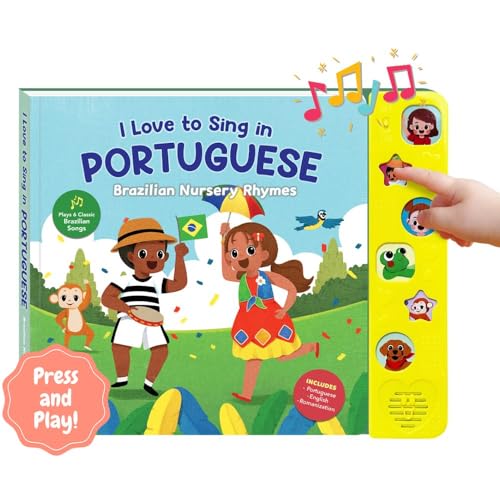
Heritage Kids Press presents a playful pathway to Brazilian Portuguese through nursery rhymes. The book combines vibrant illustrations with rhythmic songs that encourage listening and speaking. By exposing learners to common phrases and cultural nuances within a musical context, it supports vocabulary expansion and pronunciation awareness in an enjoyable format suitable for young learners and beginners of all ages.
Brazilian Portuguese Flash Cards with Audio — 75 Phrases

Briston’s 75-card set focuses on everyday conversations, with English translations and phonetic transcriptions. The included audio files via QR codes enable native pronunciation practice, helping learners refine tone, rhythm, and accuracy. This format is well suited for self-guided study, classroom use, or quick review before real-life interactions in Brazil.
Portuguese English Sound Book

Keenso’s interactive sound book introduces Portuguese and English through alphabet, numbers, animals, and more. It emphasizes hands-on learning with erasable pages for repeated practice. The bilingual format supports early learners by linking sounds to letters and common vocabulary, while the interactive elements promote engagement and memory retention in a bilingual context.
The Everything Learning Brazilian Portuguese Book

This guide covers fundamental speaking, writing, and comprehension skills for Brazilian Portuguese. Structured for beginners, it presents practical phrases, grammar guidance, and cultural notes. While format varies, the book aims to deliver a comprehensive overview that supports a balanced approach to acquiring foundational language abilities for real-world use.
Buying Guide
Choosing the right beginner resource depends on learning style and goals. Consider these perspectives:
- Format and learning style — If you prefer visual prompts and quick recall, flash cards and sound books are effective. If you want structured explanations, a traditional guide fits best.
- Audio and pronunciation — Access to audio or phonetic guides helps learners mimic correct pronunciation and intonation, which is crucial for spoken communication.
- Vocabulary breadth vs. conversation focus — Cards typically cover core phrases; phrase-heavy tools emphasize real-life dialogues for travelers and beginners.
- Age range and cultural exposure — For younger learners or families, story-based or nursery rhyme books provide cultural context and engagement.
- Portability and durability — Compact card sets and erasable books support frequent, on-the-go practice, while larger books suit longer study sessions at home.
- Upgrade path — A mix of beginner cards with a follow-up conversational book helps learners progress from recognition to speaking.
- Price and accessibility — Look for resources with optional audio access or multi-language support to maximize value over time.
Multiple perspectives ensure depth: visual learners benefit from imagery and phonetics; auditory learners rely on audio-pronunciation; and hands-on learners gain from interactive pages and erasable activities. For a balanced approach, combine a card-based set for daily practice with a structured guide or interactive book for deeper understanding and expansion of vocabulary and grammar.