Finding the right piano method can accelerate learning and keep motivation high for beginners. This guide highlights five beginner-friendly piano books from trusted publishers, each offering structured lessons, practical exercises, and clear notation. Whether you are a young student, an adult returning to the keyboard, or a total novice, these resources provide progressive paths through technique, rhythm, and repertoire.
Summary of chosen products:
| Product | Brand |
|---|---|
| PlayTime Piano: Christmas Level 1 | Beginner Holiday Sheet Music for Kids | Faber Piano Adventures |
| Adult Piano Adventures: All in One Course – Book 1 | Faber Piano Adventures |
| Czerny – Practical Method for Beginners On Pianoforte, Op. 599 | G. Schirmer, Inc. |
| Accelerated Piano Adventures: Lesson Book 1 | Faber Piano Adventures |
| Piano Adventures: Lesson Book – Level 1, 2nd Edition | FABER PIANO INSTITUTE |
PlayTime Piano: Christmas Level 1

The PlayTime Piano Christmas Level 1 book introduces early elementary players to seasonal favorites and familiar carols through a beginner-friendly format. This method aligns with a kid-friendly approach, blending melodic lines with simple rhythms to help new pianists develop finger independence and sight-reading habits. While the product page notes the book’s used condition in this listing, the core educational value remains focused on approachable pieces and basic technique patterns that fit within a short practice window each day.
Key features tied to early progress include manageable note ranges, small melodic motifs, and repetition of common patterns. The book encourages consistent practice by pairing songs with short, repeatable sections. For parents and instructors, this title provides a gentle gateway into the piano repertoire, enabling beginners to experience success with recognizable tunes while building confidence in notation and performance basics.
Adult Piano Adventures: All In One Course — Book 1

This comprehensive entry point for adult learners combines technique, theory, and repertoire within a single package. The course emphasizes practical understanding of chords, standard notation, and rhythm fundamentals while preserving an approachable pace suitable for self-guided study or co-learning with an instructor. The resource’s design supports varied skill levels, making it a versatile option for adults returning to the keyboard after time away or starting from scratch with a clear, structured pathway.
Important strengths include a broad catalog of over 90 songs that illustrate core theory concepts, a focus on arranging for adult ears, and an integrated approach to reading grand staff notation. The materials are arranged to build confidence incrementally, with exercises that reinforce technique alongside musical expression. While the listing highlights the book’s educational breadth, students should expect an emphasis on both notation fluency and performance-ready pieces.
Czerny – Practical Method for Beginners On Pianoforte, Op. 599
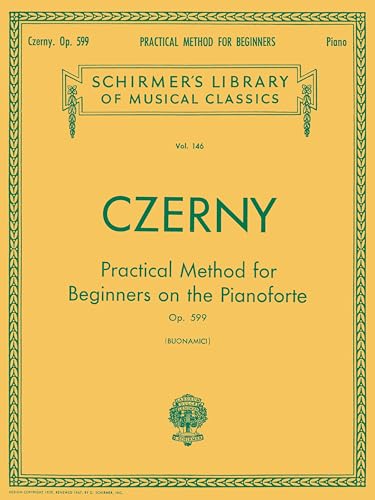
An enduring staple for developing technique, Czerny Op. 599 offers a practical progression of exercises aimed at building accuracy, hand coordination, and tone control. This Schirmer edition provides 56 pages of study material designed for beginners to cultivate classical technique through repetitive, scalable drills. While the book is a solo practice resource, instructors frequently pair it with repertoire to contextualize the technical skills within musical pieces.
Core considerations include the level of technical specificity, the value of incremental difficulty, and the balance between exercise-based drills and musical application. For learners seeking systematic technique development, Op. 599 is a well-established starting point that translates well into subsequent method books and more complex repertoire. Practicing methodically with this text can lay a foundations for reading, finger independence, and consistent tempo control.
Accelerated Piano Adventures: Lesson Book 1

Accelerated Piano Adventures Lesson Book 1 targets older beginners with a focus on essential rhythm fundamentals and grand staff reading. Published by Faber Piano Adventures, the book emphasizes a balanced approach to theory and technique, with a design that accommodates students who may progress more quickly than typical beginner learners. The material is structured to support independent practice while ensuring that foundational skills—scales, chords, and basic sight-reading—are reinforced through varied exercises and musical examples.
Notable considerations include the inclusion of a larger staff system (grand staff) and a curriculum that advances through practical musical contexts rather than isolated drills. This makes it suitable for learners who prefer a progressive, self-guided approach but still benefit from clear progression markers and teacher-guided cues. The method is compatible with other Faber titles for a cohesive learning path.
Piano Adventures: Lesson Book — Level 1, 2nd Edition

Faber’s Piano Adventures Level 1 lesson book provides a kid-friendly, structured pathway into beginner piano playing with chords, rhythm patterns, and simple melodies. The 2nd edition updates content to align with contemporary pedagogy while maintaining the familiar progressions that have made this series a staple for many instructors. The book is designed to scaffold reading and playing across a variety of musical styles, making it suitable for classrooms and home practice alike.
Key considerations include the balance between reading, hands-on technique, and musical expression. The workbook format helps learners track progress through clearly labeled sections and activities, while the accompanying repertoire reinforces practical application of new skills. The level-appropriate pieces and exercises make it accessible for a broad range of ages, from late elementary to early teens, and even motivated adults who prefer a child-friendly approach to instruction.
Piano Adventures: Lesson Book — Primer Level, 2nd Edition

The Primer Level edition introduces absolute beginners to essential note-reading, rhythm, and five-finger patterns in a friendly, approachable manner. It serves as an ideal starting point for younger students and absolute beginners while still being suitable for adults new to piano. The book blends technique with simple, engaging pieces that help establish a musical mindset early in the learning process. Instruction emphasizes a steady pace, clear musical notation, and enjoyable activities that support a consistent practice routine.
Considerations for use include the balance between rote familiarity and reading development, the potential need for supplemental repertoire to maintain motivation, and the book’s compatibility with a broader Piano Adventures sequence for continued growth. For educators, the Primer Level offers a reliable entry point to guide beginners toward more advanced levels as confidence and skill expand.
Buying Guide: Key Purchase Considerations
- Student age and prior experience: Choose a method that matches the learner’s reading ability and finger coordination. For younger students, kid-friendly interfaces and colorful notation can aid engagement; for adults, a clear theoretical component and practical notations may be preferred.
- Progression and scope: Look for a sequence that builds technique, rhythm, and reading in a cohesive arc. A single course that combines method, theory, and repertoire can simplify learning paths.
- Musical repertoire: A balanced mix of familiar tunes and varied styles helps sustain motivation while reinforcing core skills. Reputable publishers often provide supplemental songs aligned with the technique being taught.
- Notational clarity: Clear notation, legible print, and well-structured exercises support faster learning and reduce frustration, especially for beginners.
- Teacher vs. self-guided use: Some books are designed for classroom or teacher-led instruction, while others are highly suitable for self-study with minimal guidance. Consider the learner’s access to instruction when selecting.
- Practice structure: Books that include short exercises, easy-to-reach goals, and incorporations of rhythm can help establish a consistent practice routine and measurable progress.
Overall, the five selections above provide a spectrum of beginner-friendly approaches, from seasonal repertoire to systematic technique development. When choosing, consider the learner’s age, preferred learning style, and whether a single path or a multi-book sequence best supports ongoing improvement. Using these resources in combination with occasional teacher guidance can create a robust foundation for successful piano learning in the American classroom or home practice setting.