Parents and educators seeking interactive ways to teach children about the human body can rely on hands-on busy books and sound-augmented storybooks. This guide highlights five age-appropriate options that combine learning with play, focusing on anatomy, senses, and body awareness. Each pick is designed to spark curiosity, support fine motor skills, and encourage independent exploration in homes or classrooms.
| Product | Brand | Focus |
|---|---|---|
| QUOKKA Human Body Busy Books for Kids Ages 4-8 | QUOKKA | Hands-on anatomy exploration, pre-attached parts, 15 themes |
| Cali’s Books I Love My Body | Cali’s Books | Musical, emotional awareness, self-love, reflective mirrors |
| Human Body Anatomy Busy Book for Kids Ages 4-8 | BEMAXYE | 63 pages, removable activity cards, interactive learning |
| Freebear Montessori Busy Book for Kids | Freebear | Body themes, skeleton toy, cognitive and social skills |
The following sections provide concise product overviews, practical details, and how each item can fit into different learning goals—whether you’re supporting homeschooling, classroom centers, or independent play. Each entry stays objective and focused on features, usability, and educational value.
QUOKKA Human Body Busy Books for Kids Ages 4-8

This QUOKKA busy book arrives fully assembled, enabling immediate exploration of human anatomy. With nearly 200 pre-attached elements, it minimizes setup time and maximizes hands-on learning. The kit features 15 exciting themes, including the brain, organs, senses, skin, bones, and more, all designed to spark curiosity. The pages use hook-and-loop fasteners to keep young learners engaged and easily navigable, encouraging repeated play and sustained focus on the body’s structures and functions.
Educational Value: The design supports early science literacy, object recognition, and fine motor skills through tactile manipulation. The clear sections help children connect vocabulary with real parts of the body, promoting memory and comprehension. The material is crafted for durability and repeated use, suitable for home learning or classroom stations.
Cali’s Books I Love My Body by Mother Moon

This interactive musical book engages toddlers through easy-to-press buttons on every page, guiding listeners through self-love and emotional awareness. The musical format reinforces memory and language development, while the lyrics promote positive body image and confidence. A notable feature is the dual mirrors—one on the cover and another inside—allowing children to see themselves as they sing along, reinforcing the book’s affirming message and encouraging self-recognition during learning.
Educational Value: Beyond anatomy basics, the book fosters emotional literacy, self-esteem, and social-emotional skills. The music-driven approach helps kids internalize concepts about their bodies in a positive, age-appropriate context. It is well-suited for early learning environments, therapy settings, or bedtime routines that blend play with discussion.
Human Body Anatomy Busy Book for Kids Ages 4-8

BEMAXYE’s activity-packed book presents 63 pages of engaging content, designed to promote critical thinking and reading comprehension alongside hands-on learning. The inclusion of 15 interactive pages and removable activity cards supports memory development, coordination, and cognitive growth. Made from thickened waterproof paper, the book withstands frequent handling, and reusable activity cards enhance long-term value for repeated study or classroom use.
Educational Value: The combination of vivid illustrations and accessible text helps children connect anatomical concepts with everyday experiences. The removable cards allow for customizable activities, enabling educators and parents to tailor lessons to individual learners and pacing. This makes it a strong option for small-group instruction or independent study corners.
Freebear Montessori Busy Book for Kids
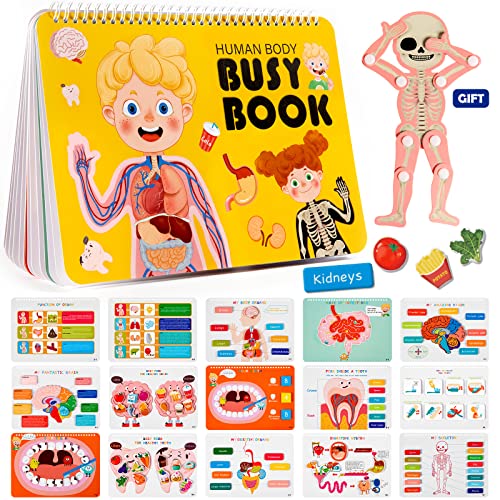
Freebear’s Busy Book blends human body themes with broader cognitive activities, making it a versatile tool for early learners. It emphasizes not only anatomy concepts but also numerical and alphabetic awareness, enabling a holistic learning experience. The book includes 15 pages across five major themes, plus a skeleton toy to extend play and exploration. This multimedia approach can support preschool, kindergarten, homeschooling, and travel activities.
Educational Value: By encouraging exploration through themed sections, children develop cognitive flexibility, language skills, and problem-solving. The included skeleton toy adds a tactile element that complements visual learning, helping children build a cohesive mental model of body structure while fostering interpersonal play and discussion about body awareness.
Buying Guide: Key Purchase Considerations
- Age appropriateness: Check age ranges and complexity. Some books suit younger toddlers with musical elements, while others target early elementary learners with more detailed anatomy activities.
- Learning style alignment: Consider whether a child benefits from hands-on manipulation, visual learning, or audio-augmented experiences. A mix of formats can support diverse needs.
- Durability and materials: Look for thick pages, reinforced bindings, and reusable components for long-term use in busy homes and classrooms.
- Engagement factors: Features like pre-attached elements, mirrors, and interactive pages can sustain attention and reduce setup time for caregivers.
- Educational scope: Some books emphasize emotion and social-emotional learning in addition to anatomy, while others focus more narrowly on body parts and systems.
- Portability and storage: Consider size, weight, and included accessories to ensure easy transport for travel or classroom centers.
- Accessibility: Large print, clear illustrations, and simple vocabulary aid early readers and children with diverse learning needs.
- Versatility: Books that combine multiple activities (coloring, matching, memory, and tactile elements) offer broader applicability for homeschool curricula and group activities.
When choosing among these options, consider a blend of instructional goals, classroom or home setup, and the child’s interests. A well-rounded kit that combines anatomy, emotional learning, and interactive play can support both cognitive development and body awareness while keeping learners motivated over time.