Finding engaging ways to build math confidence in kids can be a challenge. This guide highlights five popular educational games and books that turn arithmetic practice into entertaining activities, whether at home, in the classroom, or on the go. Each pick blends clear learning goals with playful gameplay, helping children ages roughly 6 to 12 strengthen mental math skills, number sense, and strategic thinking.
Summary of selected products
| Product | Brand | Typical Focus |
|---|---|---|
| Evermade Adsumudi Math Game | Evermade | Multiplication, Division, Addition, Subtraction |
| Math Blast! Cool Math Games for Kids 8-12 | Gartana Games | Mental math speed, variety of operations |
| Negative Number War | Math Magic | Negative numbers, quick mental math |
| The Original Math Genius Game | Island Genius | Adaptable skill levels, multiple modes |
| Scholastic 30 More Math Mysteries | Scholastic | Grade 3-5, reading-based math mysteries |
Each option targets different learning styles, from fast-paced card challenges to narrative-driven mysteries. Consider your child’s age, current math level, and interest in competitive play or cooperative problem solving when choosing the right fit.
Evermade Adsumudi Math Game
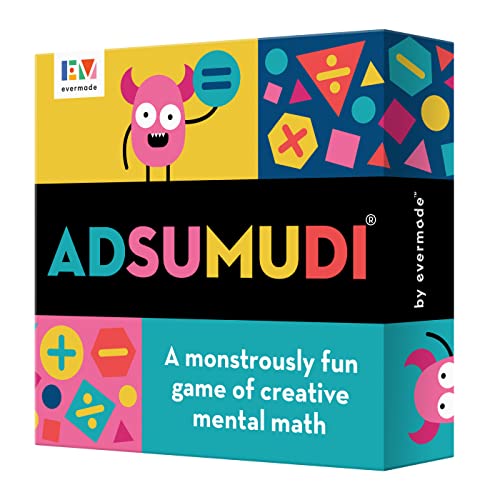
The Evermade Adsumudi Math Game focuses on sharpening mental math skills through a portable, adaptable toy. It supports practice across core operations—multiplication, division, addition, and subtraction—while presenting a fun alternative to traditional worksheets. The game is designed for kids aged 9 and up, with multiple levels on each card to tailor difficulty to a player’s skill level. For families traveling with children of varying ages, this friendly format encourages quick thinking and strategic decision-making in short play sessions.
Math Blast! Cool Math Games for Kids 8-12

Math Blast! combines 50 Challenge Cards with 75 Math Equation Cards across addition, subtraction, division, and multiplication. A 30-second timer and four dice drive fast-paced rounds that work well for small groups or solo practice. Players complete challenges, solve equations before time runs out, and accumulate points to win. The game offers solo, battle, partner, and 1-vs-1 modes, making it versatile for classroom centers or family game nights. It’s ideal for reinforcing quick mental math in a dynamic, competitive setting.
Negative Number War

Negative Number War introduces pre-algebra concepts by focusing on adding and subtracting negative numbers in a quick, accessible format. The game’s rules are concise, enabling beginners to pick up quickly while offering enough challenge for older players or adults. Its compact deck design makes it a portable option for travel, classroom warm-ups, or informal practice sessions that keep math concepts fresh without overwhelming learners.
The Original Math Genius Game

Math Genius offers skill-level adaptability with beginner, intermediate, and advanced options, ensuring suitability for kids ages 6-12. The game supports competitive play or solitaire modes, providing flexibility for different settings. By emphasizing problem-solving and strategic thinking, this title aims to promote mathematical proficiency in a collaborative or independent format, making it a strong option for both homeschool environments and classroom use.
Math Curse

Scholarly yet playful, Math Curse offers a narrative approach to math challenges for a broad age range. By framing math problems within engaging scenarios, the book helps readers connect math concepts to real-world contexts. The accessible format supports readers from early elementary through middle school ages who enjoy storytelling and problem solving as a pathway to stronger numeracy.
Scholastic 30 More Math Mysteries

Scholastic’s 30 More Math Mysteries invites readers to solve standalone math riddles in a grade-appropriate format (Grades 3-5). With 80 pages and a light weight, this book is well-suited for classroom activity stations, independent reading time, or after-school enrichment. The mysteries blend literacy and math, encouraging critical thinking and perseverance as students work through clues and multiple steps.
Buying Guide: Key Considerations for Selecting a Math-Focused Product
Choosing the right math game or book depends on several factors. First, assess the child’s current math level and the specific skills you want to reinforce—basic arithmetic, mental math speed, or number concepts. Next, consider the preferred format: card games for quick bursts of practice, board games for collaborative play, or books that offer narrative contexts to sustain engagement. Portability matters for travel and short sessions, while durability helps with ongoing use in busy households or classrooms.
- Age and skill alignment: Look for products clearly labeled for the target age range and skill level. Adaptable options help accommodate growing abilities.
- Learning goals: Decide whether you want speed and challenge (timer-based games), conceptual understanding (mystery or story-based books), or a mix of both.
- Group dynamics: If you have multiple children or students, choose games that support 2-6 players or offer solo play modes to keep everyone engaged.
- Durability and portability: Cards and compact game elements should withstand frequent handling and travel use.
- Supplemental learning: Some products pair well with classroom curricula or homeschool plans, offering structured activities beyond casual play.
Incorporate a mix of formats to keep practice engaging. For example, alternate between fast-paced card games to build fluency and longer, narrative-driven books to deepen mathematical reasoning. Monitor progress through quick checks or informal quizzes to tailor future selections to a child’s evolving needs.