Finding engaging math books for elementary students helps build confidence, reinforce skills, and foster a love of learning. This guide highlights five accessible titles that cover addition, subtraction, place value, and foundational math concepts. Each pick is suitable for home study, tutoring, or classroom warm-ups, with features designed to support daily practice and long-term math fluency. Explore options from trusted publishers, and use the buying guide to compare formats, difficulty levels, and instructional focus.
| Product | Brand | Key Focus |
|---|---|---|
| School Zone Addition & Subtraction Workbook | School Zone | Addition, subtraction, place value, regrouping |
| Everything You Need to Ace Math in One Big Fat Notebook | Workman | Comprehensive math reference and practice |
| Channie’s One Page A Day Single Digit Addition & Subtraction Workbook | Channie’s | Single-digit operations, visual practice |
| Carson Dellosa Common Core Math 4 Today | Carson Dellosa Education | Daily practice, Core-aligned skills |
School Zone Addition & Subtraction Workbook

This 64-page workbook targets early arithmetic skills essential for first and second graders. The content covers basic addition and subtraction, but also introduces place value concepts, differences, regrouping, and fact tables. The workbook format helps children practice timed drills and progressively build fluency. It is designed for classroom use or homeschooling, with activities that adapt to varying skill levels. The pages are organized to guide students from simple to more complex problems, reinforcing accuracy and speed over repeated practice. A reliable option for reinforcing foundational math at home.
Features include a structured progression that mirrors common core sequences and the flexibility to tailor activities by student need. The activities emphasize core skills while using kid-friendly visuals to keep learners engaged. Teachers and parents may appreciate the ready-to-use format, allowing quick implementation without extensive preparation. Overall, this workbook supports daily math routines and provides a tangible way to track improvement over time.
Everything You Need to Ace Math in One Big Fat Notebook

This volume serves as a comprehensive math study guide for middle school, offering structured explanations, examples, and practice problems. While targeted at older students, its clear, approachable tone can benefit motivated elementary learners ready for broader exposure to math concepts, problem-solving strategies, and study routines. The book consolidates essential topics—fractions, decimals, proportions, and operations—into a digestible format with visual aids and concise summaries. It can be particularly effective as a bridge resource for students approaching upper-elementary math standards or advanced practice at home.
Key strengths include accessible explanations, step-by-step examples, and a broad range of practice problems. The big-notebook style supports independent learning or guided sessions with a tutor. Parents seeking a single reference to accompany daily worksheets will find this book useful for reinforcing concepts encountered in class and boosting confidence with self-directed study habits. However, some early elementary readers may require scaled-down activities or parental guidance to maximize usefulness.
Channie’s One Page A Day Single Digit Addition & Subtraction Workbook

This workbook is tailored for pre-kindergarten to first-grade students, focusing on single-digit addition and subtraction with highly visual, color-coded blocks. Daily practice uses 25 problems per page, making it ideal for short, consistent sessions. The workbook emphasizes alignment and number-size consistency to reduce confusion, with visual anchors to separate problems from answers. It supports early handwriting skills through simple, legible exercises and is praised for its suitability for homeschooling, special education, and classroom warm-ups.
Its design prioritizes ease of use and steady progress. Parents and teachers can leverage the color-coded approach to help learners visualize math concepts and build automaticity. The single-digit emphasis aligns with foundational grade-level standards, making it a reliable tool for daily practice. While the content is basic, the structured layout helps new learners gain confidence and accuracy before advancing to multi-digit problems.
Carson Dellosa Common Core Math 4 Today
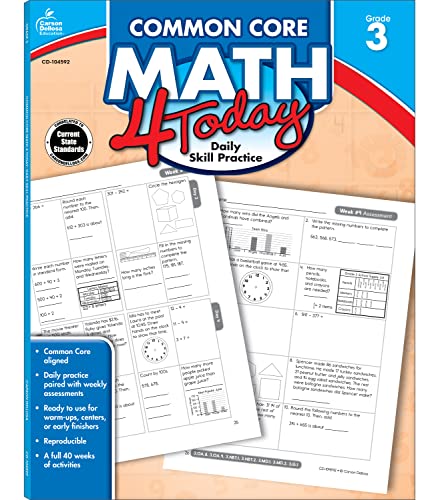
This workbook targets third-grade math with daily practice and weekly assessments. It focuses on essential topics such as telling time, fractions, and basic arithmetic operations, aligning with Common Core standards. The structure supports quick warm-ups and short practice sessions, making it suitable for classroom centers or homeschool routines. Ready-to-use formats help teachers and parents establish a consistent practice cadence while allowing for differentiation based on student needs. The combination of daily tasks and periodic checks provides a clear view of progress over time.
Strengths include its ready-to-use format, alignment with core standards, and the emphasis on ongoing practice without overwhelming students. The daily pages foster habit formation and steady skill development, while the weekly assessments help gauge understanding and inform next steps. The product is well-suited for students building precision in time, fractions, and basic operations, as well as for classrooms looking for a dependable routine that reinforces essential math concepts.
Buying Guide: Key Purchase Considerations
When selecting math books for elementary students, consider the learner’s age, current skill level, and preferred learning style. Here are important factors to weigh:
- Skill coverage: Ensure the book addresses core topics appropriate for the child’s grade, such as addition, subtraction, place value, time, or fractions. Look for a balance of concept explanations and ample practice.
- Format and pacing: Daily practice books work well for routine building, while comprehensive guides fit learners needing broader context. Decide whether short, daily tasks or longer, unit-style lessons suit the learner best.
- Visual supports: Color-coding, diagrams, and visual anchors can aid understanding, especially for younger or visual learners. Consider books that present problems in an engaging, age-appropriate way.
- Assessment and progress tracking: Weekly or periodic assessments help monitor growth. Check if the format includes quick check-ins to identify areas needing extra focus.
- Differentiation: For mixed-ability settings, select materials that offer varying difficulty within the same book or supplementary resources to accommodate different learners.
- Inclusion and accessibility: Look for clear handwriting, simple language, and inclusive examples. Materials should be easy to use for both classroom and home environments.
- Durability and usability: Check page quality and binding if the book will be used frequently. Consider digital companions or printable pages if that aligns with the learning plan.
In addition to content, think about the learner’s motivation. Books with interactive activities, quick wins, and visually appealing layouts tend to sustain engagement. Combining a structured workbook with occasional storytelling or real-life math applications can deepen understanding and promote long-term interest in math.