Finding the right math workbook or reference can support eighth graders as they tackle topics like geometry, algebra, and number sense. This guide highlights solid options that align with typical eighth-grade standards, offering practice, explanations, and ongoing reinforcement. Each entry is designed to help students build confidence and independence in problem solving, whether used at home, in tutoring sessions, or for classroom enrichment.
| Product | Brand | Focus | Key Benefit |
|---|---|---|---|
| Spectrum 8th Grade Math Workbook (Carson Dellosa) | Carson Dellosa Education | Geometric concepts, integers, rational/irrational numbers, Pythagorean theorem | Structured practice aligned with Grade 8 topics |
| Spectrum Grades 6-8 Algebra 1 Workbook (Carson Dellosa) | Carson Dellosa Education | Algebraic equations, rational numbers, functions, graphing | Transitional algebra skills with real-life applications |
| Spectrum 8th Grade Science Workbook | Spectrum | Science content across natural, earth, life science | Supports science literacy alongside math concepts |
| The 100 Series Algebra Workbook (Volume 2) | Carson Dellosa Education | Fractions, ratio, algebraic expressions, solving and graphing equations | Foundational algebra practice for grades 7 and up |
Spectrum 8th Grade Math Workbook

The Spectrum 8th Grade Math Workbook from Carson Dellosa Education focuses on key eighth-grade topics such as geometry, integers, rational and irrational numbers, and the Pythagorean theorem. It is designed for ages 13–14 and complements classroom lessons with structured practice. The workbook is a practical resource for reinforcing procedural fluency, conceptual understanding, and problem-solving strategies through a series of grade-appropriate activities. Its layout supports independent work and is suitable for both home study and targeted intervention.
Spectrum Grades 6-8 Algebra 1 Workbook
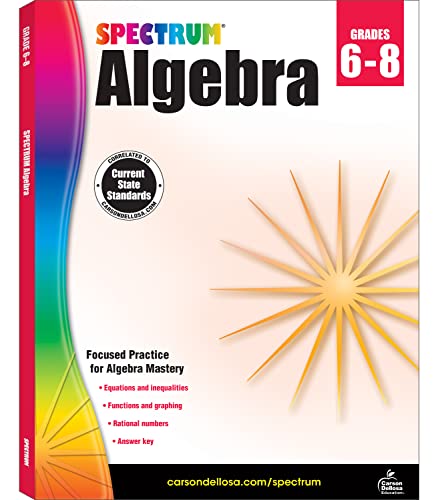
This Algebra 1 workbook covers essential algebraic topics for middle school learners, including solving equations, rational numbers, graphing, and functions. It functions well as a supplement to regular math lessons, helping students connect classroom concepts to real-world scenarios. The activities emphasize both procedural proficiency and analytical thinking, supporting students who are preparing for higher-level math coursework. Clear instructions and bite-sized tasks make it accessible for homeschool use or classroom centers.
Spectrum 8th Grade Science Workbook

While primarily a science workbook, this Spectrum title reinforces scientific literacy and inquiry skills that support mathematical thinking, especially when analyzing data, interpreting graphs, and understanding natural phenomena. It aligns with state standards and offers engaging content across natural, earth, and life sciences. For eighth-grade students who benefit from interdisciplinary approaches, it provides a balanced complement to math-focused study without duplicating content.
The 100 Series Algebra Workbook (Volume 2)

The 100 Series Algebra Workbook, Volume 2, covers fractions, ratios, algebraic expressions, and solving and graphing equations. Designed for grades 7 and up, it offers concise, modular practice that can support students transitioning to more advanced algebra. The workbook is suitable for supplemental work, homework help, or classroom enrichment, with a focus on problem-solving efficiency and gradual skill-building. It serves as a dependable resource for reinforcing algebraic foundations in eighth grade and beyond.
Buying Guide
- Curriculum alignment: Ensure the material matches your state or district standards for eighth-grade math, including geometry, algebra, and number sense.
- Practice diversity: Look for a mix of drill problems, word problems, and real-life applications to build flexibility in problem solving.
- Progression and pacing: Prefer resources with clear progression from basic to more complex topics and consumable or reusable formats that fit your schedule.
- Independent vs guided learning: Some books offer explanations and steps; others emphasize practice with minimal guidance. Choose based on your student’s needs.
- Assessment support: Worksheets, review sections, and answer keys help track growth without requiring external tools.
- Interdisciplinary value: Materials that connect math to science, technology, engineering, or arts can reinforce understanding and engagement.
- Durability and format: Consider page layout, readability, and whether a spiral or bound format suits your study routine.
- Age appropriateness: Choose levels labeled for Grade 8 or ages 13–14 to match cognitive and skill development.
- Usage context: Home practice, tutoring supplements, or classroom centers—different formats may work better for each setting.
- Supplemental resources: Some titles pair well with digital tools or teacher-guided lessons for a blended learning approach.