Finding a reliable ISBN scanner for libraries, bookstores, or personal collections can streamline inventory and checkout workflows. This guide highlights five capable options, focusing on ISBN and barcode scanning performance, connectivity, and durability. Each entry includes a quick overview and practical considerations to help you choose the right model for your space and needs.
| Product | Brand | Connection | Notable Feature |
|---|---|---|---|
| Barcode Scanner Wireless | BASECENT | Wireless 2.4G / USB wired | Very long wireless range |
| NetumScan Automatic Omnidirectional Desktop Barcode Scanner | NetumScan | Wired USB | Hands-free, omnidirectional |
| Eyoyo Bluetooth Barcode Scanner Wireless | Eyoyo | Bluetooth / 2.4G / USB | Back clip design for mobile use |
| KILOGOGRAPH Bluetooth QR Code Scanner | KILOGOGRAPH | Wireless Bluetooth / USB | 2D scanning with stand option |
| Eyoyo Mini Bluetooth Barcode Scanner | Eyoyo | Bluetooth / USB | Ultra-compact, versatile connections |
BASECENT Wireless USB Quick Laser Scanner

The BASECENT Scanner supports both wireless and wired modes, enabling flexible use in libraries or storage areas. It uses a 2.4G USB receiver for cordless scanning and can also charge via a USB cable while scanning, reducing downtime. Its 300 scans per second capability helps quickly process ISBNs and other barcodes, including UPC and EAN formats.
With long-range wireless transmission, the device can operate 60–100 meters indoors and up to 400 meters in open space, making it suitable for large clubrooms, warehouses, or multi-floor libraries. The model is designed for plug-and-scan simplicity, typically requiring no driver installation, which keeps setup straightforward for staff or volunteers.
Consider this option if you need a robust, long-range scanner that can handle diverse barcode labels in busy environments. The combination of wireless reach and fast scanning makes it a practical choice for book-heavy inventories and checkout desks where mobility matters.
NetumScan Automatic Omnidirectional Desktop Scanner

This hands-free, omnidirectional desktop scanner excels in high-volume settings. It captures 1D, 2D, and QR codes from labels, paper, or digital displays with high accuracy, including damaged or distorted codes. Its smart sensing mode activates scanning automatically when items move into position, reducing the need for manual triggers during busy operations.
The device features a non-slip base and an anti-vibration design to minimize movement or damage from drops. An IP54 rating adds some protection from dust and minor splashes, making it a durable option for daily library or store use. The consumer-friendly setup suits point-of-sale stations and quick inventory checks alike.
If you need a reliable, high-speed, hands-free scanner for checkout lanes or shelf audits, this NetumScan model offers strong performance with convenience and stability in daily workflows.
Eyoyo Bluetooth Barcode Scanner With Clip

The Eyoyo model emphasizes portability with a back-clip design that fits a wide range of phones, enabling scanning from a pocket or belt. Its 1D scanning performance is fast and accurate for common ISBNs, UPCs, and EANs, making it a practical companion for librarians on the move or staff performing quick checks on the floor.
In addition to Bluetooth, it supports a 2.4G wireless option and USB wired connectivity, providing flexibility across devices and operating systems. The scanner’s compact form factor helps reduce desk clutter while still delivering reliable barcode capture for books and other materials.
Choose this option if you prioritize mobility and compatibility with smartphones or tablets in a busy library or small bookstore environment.
KILOGOGRAPH Bluetooth QR Code Scanner
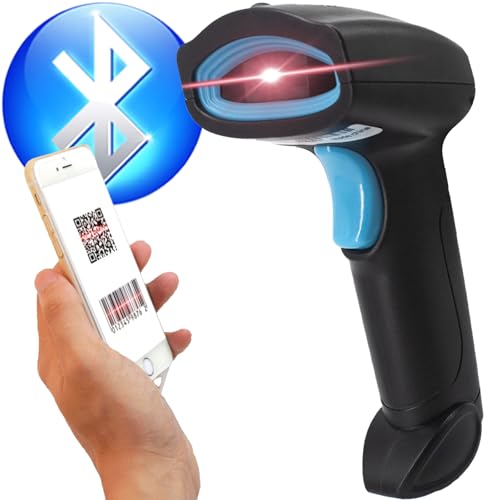
This Bluetooth-enabled scanner supports 2D and QR codes, broadening its applicability beyond 1D ISBNs. It works with laptops, tablets, and mobile devices, providing wireless flexibility for Libib or similar cataloging apps. An optional stand helps keep the scanner ready for quick drop-and-scan use in busy environments.
With both 2.4G and Bluetooth connections, this model covers a wide range of device ecosystems, reducing compatibility concerns. It’s a sensible pick for users who manage digital catalogs as well as physical shelves, especially in home libraries or small stores with diverse scanning needs.
Eyoyo Mini Bluetooth Barcode Scanner

The Eyoyo Mini Bluetooth Scanner combines pocket-friendly size with a versatile feature set, including 2.4G wireless, Bluetooth, and USB wired modes. It can transmit up to 30 meters in wireless mode and up to 50 meters via Bluetooth in open spaces, making it a practical option for mobile librarians or staff moving between shelves and checkout desks.
Equipped with an advanced CCD sensor, it handles 1D and 2D codes from paper and screen displays, including ISBNs, UPCs, and more. The compact build and robust decoding capabilities make this model well-suited for small libraries, pop-up bookshops, or on-the-go inventory tasks.
Buying Guide: Key Purchase Considerations
- Code support: If you primarily scan ISBNs, ensure the scanner reliably reads 13-digit ISBNs as well as common barcodes like UPC and EAN. Some models also handle 2D codes and QR codes for broader cataloging needs.
- Connectivity: Choose based on your environment. USB wired provides reliability; 2.4G wireless offers longer range; Bluetooth is ideal for tablets and phones. Consider devices that support multiple modes for future flexibility.
- Form factor: For librarians moving between shelves, compact handheld models or clip-on scanners are convenient. Hands-free or desktop options are ideal at checkout or inventory stations.
- Durability: In busy spaces, look for scanners with stable bases, anti-slip design, and dust or splash resistance. A stand or cradle can extend device life in frequent-use settings.
- Ease of setup: Devices that require no driver installation and offer plug-and-scan functionality save time. Quick pairing with common operating systems reduces IT overhead.
- Readability under challenging conditions: Models with omnidirectional scanning or automatic trigger sensing help maintain speed when dealing with worn or damaged codes.
- Maintenance and support: Consider brands with responsive customer support and readily available replacement parts or cables to minimize downtime.
Across library, bookstore, and personal-use scenarios, the right ISBN scanner balances speed, accuracy, and workflow compatibility. Evaluating your space, throughput, and device ecosystem will guide you toward a model that integrates smoothly with Libib catalogs, POS systems, or your preferred inventory software.