Finding engaging, cognitive-friendly activities is essential for dementia care and elder learning. The flash card sets below are designed to stimulate memory, language, and social interaction through visually rich prompts, simple prompts, and structured games. This article highlights five top options, detailing how each supports communication, recall, and engagement for dementia patients, seniors, and caregivers at home or in care settings.
| Product | |||
|---|---|---|---|
| Go Together Flash Cards for Kids & Adults | CreateFun | Matching / Speech Therapy | 50 realisitc cards; versatile for ages; promotes language and reasoning |
| Keeping Busy Let’s Chat Conversation Cards | Keeping Busy | Conversation Prompts | 112 double-sided cards; 224 questions; six topics |
| QUOKKA Elderly Memory Games | QUOKKA | Memory/Endings Matching | Two play modes; color-coded prompts; built-in answer sheet |
| Yigney Conversation Cards for Seniors | Yigney | Conversation Cards | 120 double-sided cards; 8 categories; cognitive and social focus |
| Keeping Busy Match The Photos with Fun Facts | Keeping Busy | Visual Matching / Discussion | Vibrant laminated cards; discussion prompts; dementia-friendly design |
Across these options, the common goals are clear: spark reminiscence, support verbal expression, and provide easy, safe materials that caregivers can use with minimal setup. The right set may depend on the patient’s stage, interests, and whether activities are done individually or in groups. The product features below summarize what each option emphasizes and how it can fit into a dementia care plan or senior activity routine.
Go Together Flash Cards For Adults And Kids

Brand: CreateFun. This 50-card set is designed for broad applicability—from speech therapy to ESL and memory development. Features include promoting clear communication, critical thinking, sequencing, verbal concepts, and conversational skills. The cards support activities for toddlers through adults and are suitable for classroom, homeschooling, and therapeutic contexts. The durable, print-friendly design makes it a practical option for ongoing dementia activities and language-building sessions.
Key considerations: versatile use across ages, strong emphasis on communication and reasoning, and suitability for a range of settings (home, classroom, therapy). A good fit for caregivers seeking a flexible tool to create conversation-based matching games or memory tasks.
Keeping Busy Let’s Chat Conversation Cards

Brand: Keeping Busy. This kit provides 112 double-sided cards with 224 prompts organized into six topics, designed to foster conversation and reminiscence for seniors with dementia. The box includes usage guidance, making it practical for caregivers and activities staff. The prompts encourage social interaction, memory recall, and decision-making, which can contribute to cognitive engagement and mood improvement in group or one-on-one settings.
Key considerations: comprehensive prompt coverage, caregiver guidance included, and strong emphasis on reminiscence and conversation. Best for social settings or family interactions where meaningful dialogue helps maintain cognitive activity.
QUOKKA Elderly Memory Games

Brand: QUOKKA. This set offers two play styles: solo memory mode and lively group play. Cards feature bold beginnings or finishes with color-coded backs for quick checks, plus an included answer sheet. Visual cues support recognition and recall, while the two-level design accommodates varying abilities. It’s suitable for individual practice or small group activities in care homes or family environments, preserving cognitive engagement through structured recall and language use.
Key considerations: flexible play modes, built-in verification to reduce frustration, and accessible color-coding. Choose for varied dementia stages and when you want both solitary practice and social interaction in the same toolkit.
Yigney Conversation Cards For Seniors

Brand: Yigney. This collection includes 120 double-sided cards across eight categories, designed to improve memory, cognitive skills, and social interaction through carefully crafted questions. The categories help caregivers tailor sessions to interests, which can boost engagement and reduce frustration. The material’s design supports seniors in both home and care settings, providing a structured yet flexible framework for meaningful conversation and cognitive stimulation.
Key considerations: category-driven prompts that can be customized to individual interests, and a balanced mix of cognitive challenge and accessibility. Ideal for structured daily activities or themed reminiscence sessions.
Keeping Busy Match The Photos With Fun Facts

Brand: Keeping Busy. This set focuses on matching photos with accompanying facts, designed for dementia-friendly engagement. The memory- and discussion-oriented prompts are complemented by laminated cards and a discussion guide booklet, promoting reminiscence, conversation, and cognitive training. It supports seniors with dementia and Alzheimer’s by encouraging memory recall and social interaction in a visually engaging format.
Key considerations: durable materials, supportive discussion prompts, and the combination of visual and verbal tasks. Suitable for group sessions or independent practice with caregiver support.
300 Noun Vocabulary Builder Flash Cards

Brand: CreateFun. This set features six sub-sets totaling 300+ cards focusing on nouns. Used by speech-language pathologists and educators, it’s designed to enhance visual recall, problem solving, and critical thinking. Card size is 3.5″ x 4.5″ and is notably larger than average, aiding readability and recognition. It can support dementia patients through targeted vocabulary work and language-building activities in therapy or home settings.
Key considerations: high card count with broad vocabulary coverage, clinician-friendly design, and larger card format for easier handling. Appropriate for structured language sessions and independent practice with supervision.
50 Noun Flashcards

Brand: SpriteGru. This value pack includes 50 double-sided noun flash cards with real-life photographs on the front and just the word on the back. Large cards measure about 4” x 5.8”, boosting visibility and ease of use. The set supports language development and vocabulary building for adults and children, making it versatile for autism programs, ESL, dementia care, and general communication.
Key considerations: large, clear imagery; simple back-side labeling; practical for quick prompts and memory rehearsals. A solid choice for caregivers seeking concise, visually driven vocabulary tools with straightforward usage.
Zorythm Reusable Word Search Cards
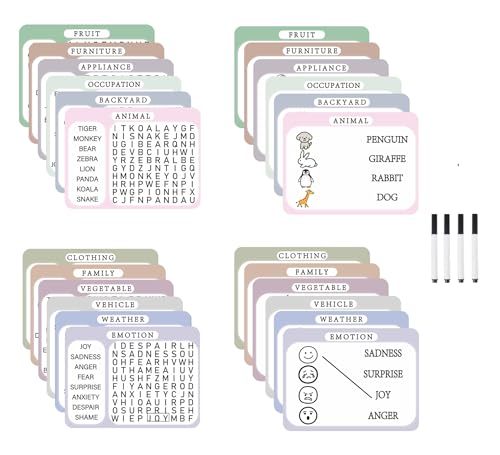
Brand: Zorythm. Each set contains large-print word search cards that can be reused and easily wiped clean. The front presents bold text, while the back provides matching visuals. The design supports cognitive exercise, language recall, and visual scanning—useful for Alzheimer’s care, nursing facilities, and independent activities with caregiver support. The sturdy build and rounded edges enhance safety and longevity in daily use.
Key considerations: large print for accessibility, reusability, and a simple to use word-search format that balances challenge with achievability. A practical option when patients benefit from routine, low-frustration cognitive activities.
Buying Guide
- Care needs and stage: match the complexity and prompt style to the patient’s cognitive abilities and progression.
- Group vs. individual use: consider sets that support both formats or combine multiple kits for versatility.
- Visual accessibility: prioritize large cards, high-contrast imagery, and clear text to reduce confusion and fatigue.
- Content relevance: select themes aligned with patient interests to boost engagement and memory retrieval.
- Durability and safety: choose laminated or sturdy cards with rounded edges for long-term use and care settings.
- Caregiver support: look for kits that include usage guidelines, prompts, or structured activity ideas to ease planning.
- Assessment potential: some sets provide built-in ways to gauge engagement, prompts, and response quality for progress tracking.
In selecting flash cards for dementia patients, it’s helpful to gather feedback from caregivers and care teams, trial different prompts, and observe how patients respond to visuals, language, and interaction opportunities. Combining vocabulary, reminiscence, and social interaction within a flexible toolkit can support ongoing cognitive engagement and quality of life.