Choosing the right dictionary helps high school students build strong writing and reading skills. This article highlights five highly regarded Merriam-Webster resources that align with school curricula and study habits. Each option offers reliable word definitions, usage guidance, and practical reference tools to support essays, reports, and exams.
Summary table of selected products:
| Product | Key Benefit | Format |
|---|---|---|
| Merriam-Webster’s Everyday Language Reference Set | Comprehensive language reference with dictionary, thesaurus, and vocabulary builder | Print set |
| Merriam-Webster’s School Dictionary | Extensive word definitions and usage examples tailored for high school | Hardcover |
| Merriam-Webster’s Dictionary and Thesaurus | Combined dictionary and thesaurus with broad entries | Mass-market paperback |
| Merriam-Webster’s Intermediate Dictionary | Student-focused reference with classroom-friendly content | Paperback |
| Merriam-Webster’s Pocket Dictionary | Compact, durable reference for quick lookups | Pocket paperback |
Merriam-Webster’s Everyday Language Reference Set

The Everyday Language Reference Set combines three essential tools: The Merriam-Webster Dictionary, The Merriam-Webster Thesaurus, and The Merriam-Webster Vocabulary Builder. This integrated package provides quick, reliable word definitions, clear usage notes, and a robust thesaurus for finding alternates and improving style. It is crafted to support high school assignments, research papers, and exam prep, while remaining economically priced for student budgets. The set also makes a thoughtful gift for graduates preparing for college-level writing.
Merriam-Webster’s School Dictionary

This high school–oriented dictionary provides extensive word coverage with practical features. It details 100,000 defined words and includes 28,000 usage examples, 500 synonym paragraphs, and 1,000 illustrations. The hardcover edition is built to withstand daily classroom use, making it a durable long-term reference for homework, tests, and project work. Its rich examples help students understand context, collocations, and nuanced meanings.
Merriam-Webster’s Pocket Dictionary, Newest Edition

The Pocket Dictionary remains a convenient, portable reference for quick word lookups and basic definitions. Its compact size makes it ideal for students who need a reliable resource for on-the-go study, class notes, or late-night revisions. The format focuses on essential vocabulary without overwhelming detail, which can be beneficial for building foundational language skills.
Merriam-Webster’s Medical Dictionary, Newest Edition
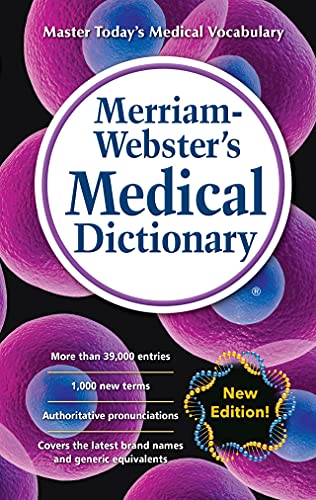
Note: This resource focuses on medical terminology and may be most relevant for students pursuing health sciences. It offers essential medical language definitions and current drug names, supporting biology and health-related coursework. While not a primary general dictionary, it is a valuable specialized reference for exam prep and research in medical topics.
Merriam-Webster’s Dictionary and Thesaurus

This mass-market paperback pairs a robust dictionary with a large thesaurus, offering 60,000 dictionary entries and 13,600 thesaurus entries in a single volume. Students gain quick access to word meanings, usage notes, and a broad set of synonym possibilities. The all-in-one format supports essay writing, vocabulary expansion, and revision tasks, making it a versatile classroom companion.
Merriam-Webster’s Intermediate Dictionary

The Intermediate Dictionary is designed with classroom needs in mind, providing accessible entries and learning-focused content. It supports students who are transitioning to more advanced vocabulary and complex writing tasks. The edition emphasizes clarity and usability, helping learners find precise meanings and example sentences suitable for school assignments.
Buying Guide
Key purchase considerations help determine the best dictionary choice for a student’s needs:
- Scope and depth: For broad vocabulary and cross-disciplinary use, consider a combined dictionary and thesaurus or an Everyday Language Reference Set. For targeted study, a school dictionary or intermediate edition may suffice.
- Format and durability: Hardcover options offer long-term classroom use, while pocket editions are ideal for on-the-go study. Durability matters for daily handling and transport between classes.
- Word coverage and examples: Look for thousands of definitions with usage examples to illustrate real-world context and help with essay writing and tests.
- Illustrations and aids: Illustrations, word histories, and usage notes can aid comprehension and memory, especially for visual learners.
- Edition and updates: Newer editions reflect contemporary language, including recent terms, brand names, and evolving usage.
- Specialized content: If a student leans toward health sciences, medical terminology resources offer targeted vocabulary beyond general dictionaries.
- Price and value: An all-in-one set can provide cost savings and integrated resources, while individual titles may suit specific needs or budgets.
- Digital availability: Some dictionaries offer online access or mobile-friendly formats, which can complement print references and support remote learning.
Overall, the best choice depends on the student’s coursework, study habits, and the balance between portability and comprehensive reference material. For a well-rounded set, many educators recommend beginning with a solid school dictionary or dictionary-thesaurus combination, supplemented by a portable option for quick lookups on the go. Students who engage with multiple resources tend to develop richer vocabularies and stronger writing skills over time.