Choosing the right calculator can streamline college math courses, from algebra and statistics to calculus and engineering. This guide highlights five strong options well-suited for math-heavy programs, balancing function variety, display clarity, and reliability. Each product is evaluated on features that matter most in higher education, such as natural textbook displays, graphing capabilities, and long-lasting power. Use the buying guide to compare essentials like display type, function depth, and power sources to find the best fit for your curriculum.
| Product | Brand | Link |
|---|---|---|
| Casio fx-115ES Plus 2nd Edition | Casio | Amazon |
| Casio fx-300ES Plus 2nd Edition | Casio | Amazon |
| Casio fx-9750GIII Graphing Calculator | Casio | Amazon |
| iPepul 552 Functions (Type-C Rechargeable) | iPepul | Amazon |
| iPepul 417 Function Pink 991ES Plus | iPepul | Amazon |
Casio fx-115ES Plus 2nd Edition

The Casio fx-115ES Plus 2nd Edition is a staple for middle school through college math, offering a robust suite of mathematical capabilities and a Natural Textbook Display℠. With over 280 functions, it supports complex number calculations, regression, statistics, and calculus basics. The natural display mirrors textbook presentation, helping students interpret fractions, equations, and graphs in familiar formats, which can reduce learning curves in algebra and introductory calculus.
Designed for reliability in exams and daily coursework, this model integrates an extensive function set with an easy-to-read display. It is suitable for courses such as Pre-Algebra, Algebra I and II, Geometry, Trigonometry, and Physics. The device emphasizes portability and straightforward operation, making it a practical choice for students who want depth without sacrificing ease of use.
Casio fx-300ES Plus 2nd Edition
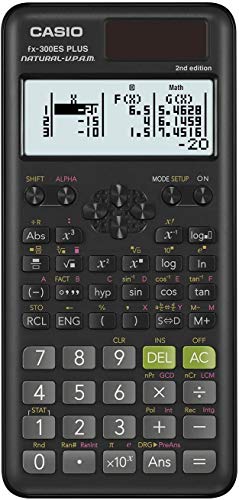
The fx-300ES Plus 2nd Edition offers 262 built-in functions and a Natural Textbook Display℠, making it adept for algebra, statistics, and early calculus. The device focuses on clarity for fractions, exponents, and trigonometry, enabling students to input expressions as they appear in textbooks. With a broad function set including statistics, regression, and calculus-ready features, it suits college math sequences that demand quick, accurate computations and easy interpretation of results.
Its balance of essential scientific functions and a readable interface helps learners who value consistent performance in exams and problem sets. While not a graphing calculator, the fx-300ES Plus remains a cost-effective option for students who need a dependable scientific calculator for math-heavy coursework.
Casio fx-9750GIII Graphing Calculator
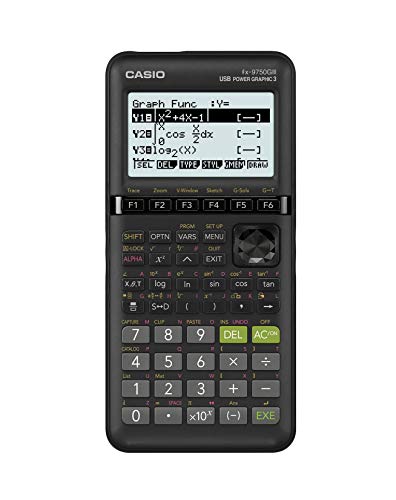
The fx-9750GIII is a graphing calculator designed for advanced math, STEM, and engineering courses. It supports plotting graphs, vectors, probability distributions, spreadsheets, and more. The Natural Textbook Display℠ helps students input and interpret expressions exactly as written in textbooks, while the Python programming capability expands learning opportunities for algorithms, data analysis, and exploratory projects. This model is well-suited for AP courses, college algebra, calculus, statistics, and STEM labs where visualization and programming are beneficial.
iPepul 552 Functions Type-C Rechargeable
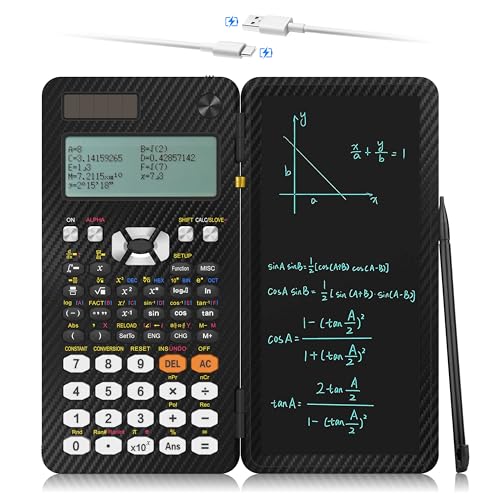
The iPepul calculator with 552 calculation functions offers extensive scientific coverage, including trigonometric, exponential, calculus, statistics, and linear algebra features. Its notepad integrated with a locking screen aids note-taking while solving problems, a practical feature for lectures and study sessions. Powering via solar and Type-C charging ensures long-term usability in classrooms, libraries, or study spaces, making it a versatile option for college math majors who frequently switch between tasks and note-taking.
iPepul 417 Function Pink 991ES Plus

The iPepul 991ES Plus in pink features 417 calculation functions and a four-line display, designed for clear readability and efficient problem-solving. It supports natural textbook display for intuitive input and output of mathematical expressions, making it suitable for algebra, trigonometry, statistics, and introductory calculus. Dual power from solar and battery ensures continued use across campus settings, including libraries and classrooms where power access may vary.
Buying Guide: Key Purchase Considerations
- Display type and readability — Natural Textbook Display℠ is preferred for understanding fractions and equations as presented in textbooks. Four-line displays help track long calculations, especially in multi-step problems.
- Function depth — For college math, look for a mix of scientific and graphing capabilities. Graphing or programming features are valuable for calculus, statistics, linear algebra, and STEM coursework.
- Power source — Solar-powered units with battery backups reduce maintenance and replacement costs in busy campus environments. Type-C charging adds modern convenience for frequent device charging.
- Note-taking integration — Calculators with built-in notepads or note-keeping aids can boost learning efficiency by combining calculation and annotation in one device.
- Durability and portability — Lightweight designs ease transport between classes, libraries, and study groups, while sturdy builds withstand daily campus use.
- Exam considerations — Ensure the calculator complies with your course and exam requirements. Some programs prefer non-programmable or academically approved models for tests.
When selecting among these options, consider your curriculum, the level of graphing or programming you’ll need, and how often you’ll rely on notes during problem solving. The Casio models provide solid scientific capabilities with clear displays, while the Casio fx-9750GIII adds graphing and Python programming for advanced coursework. The iPepul series emphasizes integrated notepads, extended function sets, and rechargeable power, appealing to students who value multitasking and long study sessions.
Overall, choosing a calculator that aligns with your major and coursework can improve efficiency, accuracy, and confidence in complex math topics. The five options above cover a spectrum from foundational scientific calculators to graphing and programming models, helping students prepare for college math success.
Buying Guide: Key Purchase Considerations and Comparisons
- Display and input — Natural textbook displays simplify input and interpretation of fractions and expressions. Graphing displays are essential for higher-level math and data visualization.
- Function breadth — For STEM majors, prioritize models with extensive statistics, calculus, and linear algebra capabilities, plus programming options if available.
- Power and reliability — Solar with a rechargeable battery minimizes interruptions during long study sessions and exams.
- Note-taking features — Integrated notepads or note-taking tools can enhance learning by allowing calculations and annotations to coexist.
- Durability and portability — Compact, lightweight devices are ideal for students who move between classrooms and libraries frequently.
- Exam compatibility — Check your course or department’s calculator policy to ensure your chosen model is permitted on exams and standardized tests.