Libraries seeking scalable digitization can benefit from advanced book scanners that flatten pages, reduce glare, and support multiple languages. Below, five top options are evaluated for institutional use, highlighting image quality, OCR capabilities, compatibility, and ease of integration with library workflows.
| Product | Brand | Key Feature | Languages | Compatibility |
|---|---|---|---|---|
| CZUR ET24 Pro | CZUR | 24MP camera with auto-flattening | 180+ | Windows, macOS, Linux |
| CZUR ET MAX Pro | CZUR | 38MP, curve-flattening, high-speed OCR | 180+ | Windows, macOS, Linux |
| CZUR Aura Pro | CZUR | AI-assisted flattening, foldable for portability | 180+ | Windows, macOS |
| CZUR Shine Ultra | CZUR | One-second page scans, A3 support | 180+ | Windows, macOS |
| VIISAN Large Format | VIISAN | Large-format A2/A3 with auto-flatten | Multilang | Windows, macOS |
CZUR ET24 Pro Professional Book Scanner
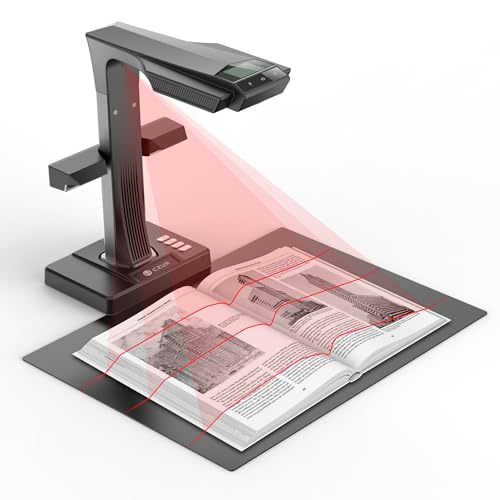
The CZUR ET24 Pro combines a 24MP camera with advanced flattening technology to reduce page distortion after pixel transformation. It supports A3 documents and provides OCR in 180+ languages. It is compatible with Windows, macOS, and Linux, broadening deployment in mixed IT environments. This model emphasizes glare reduction and reliable deskew performance, aiding librarians in digitizing fragile or curved pages with consistent results.
Key features include: 24MP HD camera at 320 DPI, high-resolution output, and an upgraded flattening system that smooths 3D curved pages. Linux compatibility targets institutional setups with open-source or Linux-based workflows. Note that papers with strong glare may require careful handling or lighting adjustments.
CZUR ET MAX Pro Professional Book Scanner

The ET MAX Pro features a high-resolution 38MP CMOS sensor with 7168 × 5376 resolution and 410 DPI. Its patented curve-flattening technology automatically flattens curved pages, delivering distortion-free scans without unbinding the book. This makes it well-suited for libraries dealing with bound volumes, journals, and thick manuscripts. The scanner also supports OCR to create editable text and searchable PDFs in multiple languages, with some language exclusions noted for OCR accuracy.
With USB high-speed connectivity and broad OS support (Windows, macOS, Linux), the ET MAX Pro aligns with diverse library IT ecosystems. Its emphasis on precise geometry and fast throughput supports digitization projects that require both speed and fidelity, particularly for archival material that benefits from accurate line-work and layout preservation.
CZUR Aura Pro Book & Document Scanner

The Aura Pro emphasizes AI-assisted scanning with auto-flattening and a foldable, portable design. It supports A3 and A4 sizes and provides multi-language OCR. The device operates with Windows and Mac OS and is controlled via the CZUR app, offering fast two-second per-page scans. Its glare-free lighting and non-flicker lamps help maintain readability on glossy or fragile pages, an important feature for library collections.
Features include a Smart Lamp for improved illumination, programmable page-turn detection, and a foot pedal option to initiate scans. The Aura Pro prioritizes efficiency and user-friendly workflow integration, especially in libraries where staff turnover or shared equipment is common.
CZUR Shine Ultra Smart Portable Scanner

The Shine Ultra is a slim, portable document camera capable of scanning up to A3 and A4 sizes with high speed. It supports Windows and macOS, and includes CZUR’s flattening technology to reduce curvature effects on book pages. The device functions without Wi-Fi or Bluetooth, which helps with security-conscious library environments. Output formats include JPG, PDF, and Word, with ABBYY OCR for text recognition across 180+ languages. TIFF output requires post-processing.
Its portability makes it suitable for temporary digitization stations or makerspace rotations within libraries. The Shine Ultra’s speed and software integration help staff deliver quick previews and full-text searchability for patrons and researchers alike.
VIISAN Large Format Book & Document Scanner

VIISAN offers a large-format solution with A2/A3 capture capability and a 26MP sensor, enabling high-detail scans of oversized documents, maps, and magazines. Auto-flattening and fingerprint removal technologies help preserve readability and reduce manual correction. The setup supports Windows and macOS with multi-language OCR capabilities, making it suitable for international or multilingual collections. The large working area benefits special collections and rare materials requiring expansive scans without stitching.
While supporting large formats, the VIISAN S21 family often emphasizes collaboration features and remote work suitability. Its higher-resolution capture supports detailed archival work, while software enhancements enable efficient workflow integration for libraries handling diverse formats.
Buying Guide
- Document size and format: Choose a scanner that matches your collection’s typical sizes (A3, A4, A2) and whether you need large-format capabilities for maps or posters.
- Flattening and deskew technology: Prioritize models with effective curve-flattening to minimize manual post-processing and to preserve page geometry for OCR accuracy.
- OCR language support: Verify that the OCR engine covers the languages present in your library’s holdings; note any language exclusions to plan for manual review.
- Software integration: Look for compatibility with library workflows, including PDF/A output, searchable PDFs, and Word/Excel export options for metadata-friendly digitization.
- Operating system compatibility: Ensure the device supports Windows, macOS, and Linux if your IT environment is mixed; consider software updates and driver availability.
- Workflow features: Auto page-turn detection, foot pedal triggering, and glare-free lighting can improve throughput and staff ergonomics in busy library environments.
- Security and network: For shared devices, prioritize models that work offline or with secure networks to minimize exposure to external threats.
- Portability vs. throughput: If you run mobile digitization events or temporary scanning stations, portable options with fast scanning speed may be advantageous.