Choosing the right book scanner for a library means balancing speed, image quality, and ease of use. This guide highlights five leading CZUR models to help libraries digitize collections efficiently, with features like auto-flattening, high-resolution cameras, and multi-language OCR. Each option is evaluated for its suitability in settings ranging from small libraries to community archives, with attention to compatibility, software support, and workflow integration.
| Product | Document Size | Key Feature |
|---|---|---|
| CZUR Aura Pro Book & Document Scanner | A3/A4 | AI-powered processing with foldable design |
| CZUR ET24 Pro Professional Book Scanner | A3 | 3rd Gen Auto-Flatten & Deskew |
| CZUR ET MAX Professional Book Scanner | A3 | 38MP camera, high-speed scanning |
| CZUR Aura Pro Portable Book Scanner | A3 | Foldable, auto-flatten, USB-centric |
| CZUR Shine Ultra Pro 24MP Document Scanner | A3 | 24MP, high DPI, versatile formats |
CZUR Aura Pro Book & Document Scanner

The Aura Pro combines rapid scanning with AI-assisted processing. It supports both A3 and A4 formats and includes auto-flattening for curved pages, reducing manual intervention. It features glare-free lighting and multiple color temperature settings, making it suitable for library collections that include glossy materials. It connects without WiFi or Bluetooth, and is controlled via the CZUR app, with output options including JPG, Word, PDF, and searchable PDF. Compatibility spans macOS and Windows operating environments.
CZUR ET24 Pro Professional Book Scanner
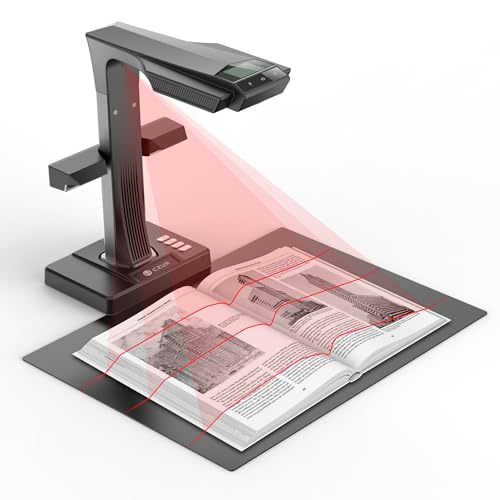
The ET24 Pro emphasizes 24MP capture with 320 DPI and 5696×4272 resolution. It advances flattening technology to smooth curved pages after pixel transformation and supports a broad OS range, including Linux. This makes it suitable for larger digitalization projects that require high detail and robust language support, with 180+ languages OCR. It is designed to work across desktop and laptop platforms, providing reliable performance for library workflows.
CZUR ET MAX Professional Book Scanner

The ET MAX delivers high-resolution scanning with a 38MP CMOS sensor and 7168×5376 pixel output at 410 DPI. Its patented curve-flattening technology automatically flattens bound pages, reducing distortion and the need to unbind. The scanner includes powerful OCR that converts scans into editable formats with broad language support (180+ languages). It’s designed for Windows, macOS, and Linux environments, making it a strong choice for libraries with diverse operating systems.
CZUR Aura Pro Portable Book Scanner

The Aura Pro Portable emphasizes foldability and portability without sacrificing flattening capability. It uses laser-assisted flattening to reproduce flat pages from curved books and includes AI-enhanced software to simplify scanning and processing. It works with macOS 10.13 or later and Windows systems, delivering fast scans at approximately two seconds per page. Supplemental lighting reduces glare, and a foot pedal supports hands-free operation for library tasks.
CZUR Shine Ultra Pro 24MP Document Scanner
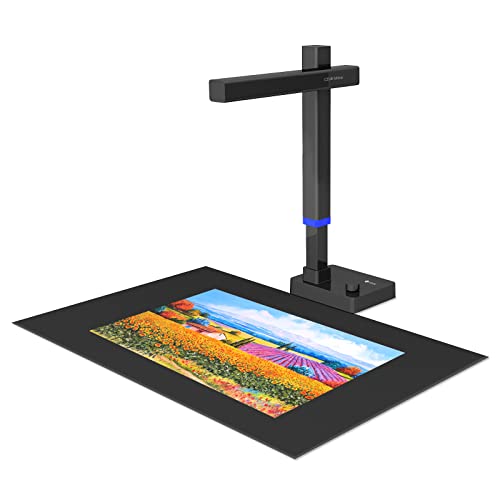
The Shine Ultra Pro focuses on 24MP capture with 440 DPI on A4 and 320 DPI on A3. It supports flatbed scanning for flat papers and ships with CZUR’s flattening technology to minimize page curvature effects. It’s compatible with both Windows and Mac and can export to JPG, PDF, searchable PDF, Word, and Excel via ABBYY OCR. The device is positioned for users needing high detail with relatively simple setup for library digitization tasks.
Buying Guide
Key considerations when selecting a book scanner for a library include page flattening reliability, image fidelity, and workflow compatibility. Auto-flattening helps digitize bound volumes quickly, but the effectiveness can vary with book thickness and page curvature. Look for high-resolution sensors (at least 24MP) to ensure legible OCR results and accurate color reproduction on varied paper stocks. OCR language support across 180+ languages can be essential for multilingual collections. Consider OS compatibility (Windows, macOS, Linux) and whether the software supports batch processing, searchable PDFs, and export formats that align with your cataloging system.
Size and format support matter for libraries with large volumes of A3 or A4 documents. A3-capable scanners enable large-scale pages and fold-out illustrations, while A4 may suffice for most standard documents. In library environments, reliable lamps or glare-free lighting reduce retakes, improving throughput. Portability can help in branch libraries, but desktop units often deliver steadier scans for high-volume tasks. Finally, verify whether the device requires internet connectivity for OCR or software activation, and ensure your IT team has access to driver updates and maintenance support.
In practice, a mix of models can be beneficial: a high-end flatbed-style unit for thick volumes or thick margins, plus a portable or semi-portable scanner for on-site digitization in multiple rooms. For libraries prioritizing OCR searchability and metadata extraction, prioritize devices with strong ABBYY-based OCR workflows and multi-language support. For archival projects with fragile bindings, choose models with gentle flattening and page-turn detection to minimize handling risk.