Finding a reliable barcode scanner that handles ISBNs and book labels is essential for libraries, bookstores, and personal collections. The following five models blend quick 1D/ISBN decoding with versatile connectivity, long battery life, and durable builds. Use this guide to compare features, compatibility, and scanning modes to pick the best option for books and related media.
| Product | Brand | Connection | Key Strength |
|---|---|---|---|
| NETUM NT-1228BC | NETUM | Bluetooth / 2.4G / USB | High-resolution CCD, ISBN/1D codes, storage mode |
| Tera 2-in-1 Wireless | Tera | 2.4G Wireless / USB | Long battery life, rugged case, IP54 |
| NetumScan USB 1D | NetumScan | USB (Wired) | Screen scanning, durable design, multi-mode |
| NADAMOO 328ft | NADAMOO | 2.4G Wireless / USB | Long reach, large battery, multi-device pairing |
| Eyoyo Mini 1D | Eyoyo | 2.4G / Bluetooth / USB | Compact, versatile connection options, long-range 2.4G |
NETUM NT-1228BC Bluetooth Barcode Scanner

The NETUM NT-1228BC offers broad compatibility across Bluetooth HID, SPP, and BLE modes, enabling connection to iOS, Android, Windows, Mac, and Linux devices. Its 2500-pixel CCD sensor excels in decoding 1D barcodes and ISBNs on books, even when codes are worn or damaged. It supports manual, continuous, and auto-sensing scanning, plus a storage mode capable of holding up to 100,000 barcodes for offline work. This makes it suitable for libraries, bookstores, and education settings where books are scanned in various environments.
Tera Barcode Scanner Wireless 2-in-1

This Tera model combines 2.4 GHz wireless with USB 2.0 wired connectivity in a single unit, offering a longer battery life and a battery indicator. It features a curved, comfortable grip and a rugged orange silicone cover for impact resistance. With IP54 dust protection, it is well-suited for library stacks, mailrooms, and classroom use, where occasional drops and dusty environments occur. It handles 1D codes and is appropriate for scanning book barcodes on paper and screens alike.
NetumScan USB 1D Barcode Scanner

NetumScan’s USB 1D scanner emphasizes CCD technology for reliable scanning of barcodes from paper and screens, including damaged or smudged labels. It includes three scanning modes: key-trigger, auto-induction, and continuous mode. Its rugged, anti-shock body withstands drops, making it practical for busy libraries and shops. The flexible modes allow quick ISBN reads from books and other media, with smooth integration into POS or cataloging software via USB.
NADAMOO Wireless Barcode Scanner
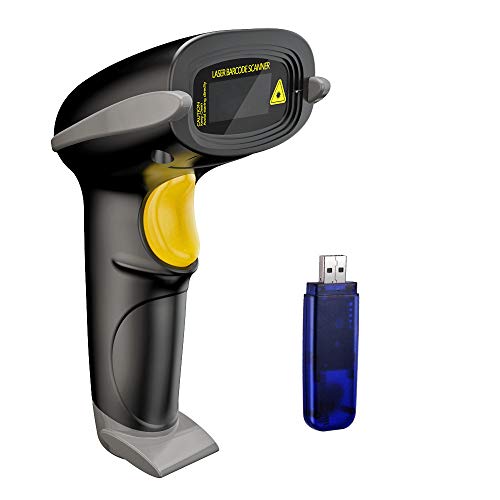
NADAMOO delivers long-range wireless performance with up to 400 meters open-air transmission and a large 2600 mAh battery. It supports one-to-one and many-to-one pairing, facilitating multiple scanners feeding a single USB receiver in a warehouse or library setting. The device is optimized for long sessions, reducing downtime between scans as books move through checkouts, returns, and shelving tasks.
Tera HW0009 With Screen

The Tera HW0009 adds a built-in screen and a charging cradle, improving workflow visibility in busy environments. Its CMOS imaging engine handles both 1D and 2D barcodes, including challenging PDF417 formats. The 2500 mAh battery supports extended use, while the cradle keeps the device charged between scanning sessions. It is suitable for libraries and bookstores that require quick, reliable scans with on-device review and light duty warehousing.
Buying Guide
Key purchase considerations for barcode scanners used with books include compatibility, decoding capability, and connectivity versatility.
- Decoding performance: Look for CCD or CMOS sensors with strong ISBN and 1D code recognition, including damaged or poorly printed labels. Optical clarity and high pixel counts improve accuracy in ISBN-heavy tasks.
- Connectivity options: A mix of Bluetooth, 2.4G, and USB wired connections offers flexibility across devices, platforms, and workstations. Consider whether you need multi-device pairing or offline storage.
- Battery life and durability: Long battery life reduces interruptions in checkout lines or inventory counting. IP ratings and rugged housings are beneficial in dusty stacks or high-traffic areas.
- Scanning modes: Auto-sensing, continuous, and manual trigger modes support different workflows, from frequent book scanning to batch processing.
- Form factor and ergonomics: A compact, comfortable grip minimizes fatigue during long cataloging sessions. Light weight and a sturdy shell lower the risk of damage from drops.
- Software compatibility: Ensure the scanner reliably interoperates with your library or POS software, whether via HID, SPP, or custom drivers.
- Price and support: While not a price guide, assess warranty terms, firmware updates, and access to customer service for troubleshooting.
For book-centered environments, prioritize scanners with strong ISBN decoding, reliable screen or paper document scanning, and flexible connectivity to library catalogs, mobile devices, and desktop systems. The products listed here provide a spectrum of options—from compact, portable units to rugged, warehouse-ready devices—so you can match performance to workload and space.