Finding strong math resources for school can boost confidence, reinforce classroom lessons, and support independent study. The following selection highlights five widely used math books and workbooks that cover foundational arithmetic, problem-solving, and core concepts across early elementary to middle school. Each pick offers structured practice, clear explanations, and activities designed for home, classwork, or tutoring sessions.
| Product | Grade Range | Benefits | Format |
|---|---|---|---|
| School Zone Addition & Subtraction Workbook | Ages 6-8 (Grades 1-2) | Place value, regrouping, and fact practice | Workbook |
| Math Curse | All ages (conceptual curiosity) | Humorous entry into math thinking | Picture book |
| Everything You Need to Ace Math in One Big Fat Notebook | Middle School | Comprehensive study guide and quick-reference | Notebook-style guide |
| School Zone Big Second Grade Workbook | Second Grade | Word problems, reading, and core math skills | Workbook |
| Carson Dellosa Common Core Math 4 Today | 3rd Grade | Daily practice with weekly assessments | Workbook |
These resources reflect a blend of practice worksheets, guided lessons, and problem-solving activities. They are suitable for students who need structured daily routines, parents seeking supportive at-home materials, and teachers aiming to supplement in-class instruction with ready-to-use tasks.
School Zone Addition & Subtraction Workbook

The School Zone workbook focuses on foundational arithmetic skills essential for early elementary students. It features a 64-page layout with activities that reinforce sums, differences, place value, regrouping, and essential fact tables. The design supports independent practice, making it suitable for after-school study or targeted skill-building during tutoring sessions. The workbook’s varied activities help learners recognize patterns and apply methods across different problem types, aligning with common core expectations for early grades.
Math Curse

Math Curse uses humor and imaginative scenarios to engage readers in mathematical thinking. While appropriate for a broad age range, it excels in encouraging curiosity, pattern recognition, and problem-solving attitudes. This title can pair well with more structured practice by inviting students to identify how math appears in everyday activities and stories, supporting deeper comprehension beyond rote procedures. It’s a good supplement for reluctant learners who benefit from a lighter, relatable entry into math concepts.
Everything You Need to Ace Math in One Big Fat Notebook

This middle school study guide consolidates essential topics into a concise, student-friendly format. The Big Fat Notebook approach presents rules, formulas, and worked examples in accessible language with practical tips. It includes a broad coverage of algebraic concepts, fractions, and problem-solving strategies, making it a reliable reference for independent study, review sessions, or last-minute cram work before tests. The pack offers comprehensive, organized content that aligns with typical middle school curricula.
School Zone Big Second Grade Workbook

The Big Second Grade Workbook combines essential math concepts with additional reading and phonics tasks, expanding learning beyond math. It includes 320 pages of practice, making it suitable for a full semester of daily activities. The workbook emphasizes word problems, reading comprehension related to math, and science connections, which can help students see math as part of a broader academic context. It’s well-suited for classroom centers or homeschooling routines that require ample practice materials for grade-level coverage.
Carson Dellosa Common Core Math 4 Today: 3rd Grade Workbook
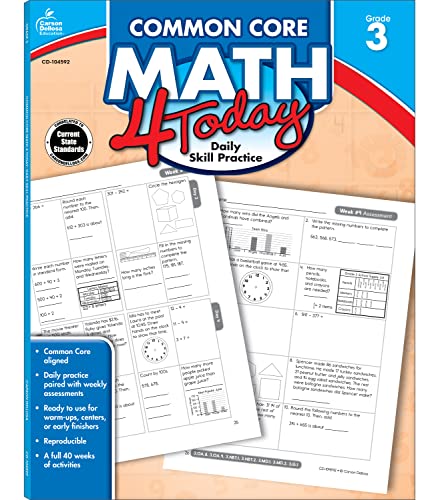
Common Core Math 4 Today provides daily practice with concise lessons and weekly assessments. It is designed for warm-ups, centers, or early finishers, helping teachers maintain consistent practice without lengthy planning. Topics include time, fractions, addition, subtraction, multiplication, division, and more, with short activities that reinforce core standards. The format supports quick feedback cycles and is adaptable for both classroom use and homeschooling routines seeking regular math reinforcement.
Spectrum Algebra 1 Workbook
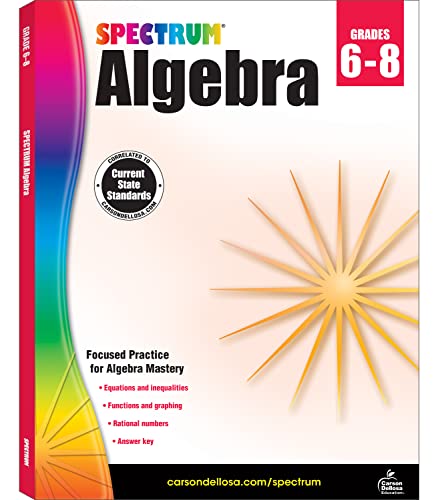
Spectrum Algebra 1 Workbook targets middle school learners with a focus on algebraic equations, rational numbers, and related topics. The workbook format emphasizes practical applications to everyday life and problem-solving strategies, making abstract ideas more accessible. It includes grade-appropriate activities and instructions that aim to extend students’ analytical abilities while providing a clear path from basic arithmetic to algebraic thinking. This resource is suitable as a bridge between core math topics and higher-level algebra preparation.
Buying Guide
Key considerations when choosing math books for school:
- Grade alignment and learning goals: Match the book’s level to the student’s current grade and the specific skills they need to build, such as place value, fractions, or algebra readiness.
- Format and approach: Decide between structured workbooks, narrative-driven titles, or comprehensive study guides based on the student’s learning style and the intended use (daily practice vs. review).
- Practice density and pacing: Consider whether the student benefits from short daily activities or longer, focused sessions. Daily practice titles can support skill retention, while larger workbooks provide breadth.
- Assessment support: Look for resources that include quick checks, unit tests, or progress tracking to monitor improvement over time.
- Alignment with standards: If possible, choose materials aligned with common core or state standards to ensure relevance to classroom lessons.
- Supplementary vs. primary material: Use these books as supplements to teacher instruction or as primary practice during homeschooling, depending on curricular needs.
- Engagement and accessibility: Visuals, humor, and clear explanations can improve persistence, especially for younger learners or students who struggle with math anxiety.
Selecting the right mix of titles can provide a well-rounded math toolkit, supporting consistent practice, conceptual understanding, and problem-solving confidence across K–8. Consider pairing a quick-reference guide with a longer workbook to balance speed drills with deeper reasoning.