Finding the right phonics program helps kindergartners learn to decode, blend sounds, and enjoy reading. This article highlights five solid options that combine structured lessons with engaging activities. Each entry includes practical features, how it supports early literacy, and what to consider when choosing for your child or classroom.
style=”font-weight:bold;”>Summary Table Of Selected Products
| Product | Brand | Format | Main Benefit |
|---|---|---|---|
| The Bambino Tree Phonics Flash Cards | The Bambino Tree | Flash cards with rings and flash cards | Structured phonogram practice across levels |
| Basic Phonics Readers – Abeka | Abeka | Printed reader set | Progressive decoding with short, decodable texts |
| Spectrum Kindergarten Phonics Workbook | Spectrum | Workbooks with practice pages | Focused phonics with integration and vocabulary work |
| Alened Phonics Flash Cards | Alened | Flash cards with games and visuals | CVC and word-building with engaging activities |
| Carson Dellosa Phonics for Kindergarten Workbook | Carson Dellosa Education | Workbook with activities and stickers | Hands-on language arts practice and motivation |
The Bambino Tree Phonics Flash Cards

The Bambino Tree Phonics Flash Cards provide a multi-level approach to phonics, designed for ages 4-8. The kit includes 62 flashcards, four sorting rings, 480 illustrated words, 120 sentences, and four difficulty levels aligned with phonogram families. Level 1 introduces kindergarten-ready CVC blending, Level 2 expands to consonant blends and digraphs, Level 3 covers long vowels and diphthongs, and Level 4 explores trigraphs and silent letters. The hands-on, game-like activities help children recognize sounds, blend words, and read simple sentences without feeling pressured. The interactive visuals keep learners engaged while teachers or parents can track progress across levels.
Considerations: This kit emphasizes systematic progression and teacher-friendly structure. It’s well-suited for small-group instruction or home practice, and its visual emphasis supports early decoding without overwhelming beginners.
Basic Phonics Readers — Abeka

Abeka’s Basic Phonics Readers present a sequential reading program that starts with one-vowel word decoding and advances to two-vowel words. The twelve small readers establish a firm foundation and foster a love of reading through decodable text and structured phonics instruction. The program emphasizes decoding, fluency, pronunciation, and comprehension with explicit guidance on vowels, blends, common consonant patterns, and sight words. It also includes oral comprehension questions to reinforce understanding. This option is especially effective for homeschool settings and early classrooms seeking a traditional phonics progression.
Considerations: Suitable for learners who benefit from a steady, cumulative approach and explicit instruction. It pairs well with teacher-led or guided reading sessions and can be used alongside other decodable materials for a well-rounded phonics routine.
Spectrum Kindergarten Phonics Workbook

Spectrum’s Kindergarten Phonics Workbook offers 144 pages of structured practice in letter recognition, vowel and consonant sounds, and phonemic awareness. The workbook emphasizes the integration of knowledge and ideas with activities that connect phonics to reading and writing. Exercises focus on structural analysis, dictionary skills, and practical word-building tasks. This resource is particularly useful for supplementing a classroom curriculum or home study plan, providing a clear, workbook-based path for early learners to practice essential phonics skills in short, focused sessions.
Considerations: Great for independent practice or guided sessions. It’s important to pair with reading aloud activities to reinforce comprehension and fluency beyond isolated phonics work.
Alened Phonics Flash Cards

Alened’s Phonics Flash Cards focus on building CVC, CVCC, and CCVC word families through visual prompts and letter-sound matching. The set includes 80 double-sided cards, 50 pictures, and four rings plus 123 cards to support a broad range of word-building activities. Color-coding helps distinguish consonants and vowels, aiding quick recognition and retention. The cards are designed for classroom games, group activities, and individual practice, making them versatile for homeschoolers as well as traditional classrooms.
Considerations: The flash-card format supports quick drills and interactive learning but should be supplemented with guided decoding practice and read-aloud sessions to strengthen reading fluency and comprehension.
Carson Dellosa Phonics For Kindergarten Workbook
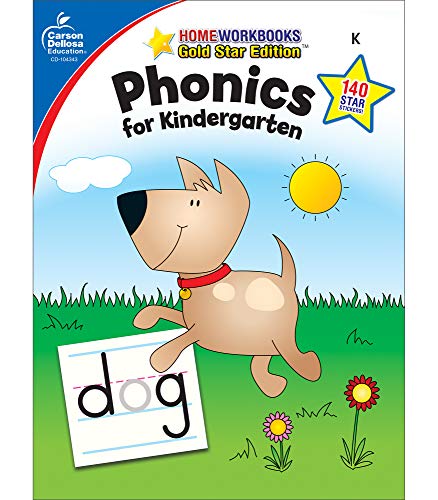
The Carson Dellosa Phonics for Kindergarten Workbook combines colorful pages, puzzles, and games to engage early readers. It supports early language arts development by aligning activities with phonics standards and providing a mix of instruction and practice. An incentive chart and 140 stickers add a motivational element that encourages consistent practice. This workbook is well-suited for homeschool curricula or classroom centers, offering flexible use alongside reading aloud and guided instruction to reinforce phonics concepts.
Considerations: This resource is best used as part of a multi-faceted approach that includes oral reading, decodable readers, and writing practice to reinforce letter-sound relations and fluency.
Buying Guide: Key Purchase Considerations And Comparisons
- Learning pace and structure: Some programs emphasize a step-by-step progression with explicit phonics rules, while others prioritize decodable reading practice and word-building games. Choose based on your child’s pace and learning style.
- Format and versatility: Flash cards and workbooks work well for independent practice and classroom centers, whereas printable or digital components can support remote or hybrid learning.
- Assessment and progress tracking: Look for materials that offer clear progress indicators (levels, decodable word lists, or comprehension prompts) so you can monitor growth over time.
- Engagement and motivation: Colorful visuals, interactive activities, and reward systems help sustain interest. Ensure the content remains focused on phonics goals and does not distract from decoding skills.
- Alignment with standards: Consider how well the program aligns with early literacy standards or your district’s curriculum to ensure cohesive instruction.
- Supplementary use: For best results, combine decodable readers with explicit phonics instruction, guided reading, and oral language activities to build reading fluency and comprehension.