Choosing the right math book for sixth grade can help students master essential skills, stay motivated, and build a strong math foundation for middle school. Below are four highly regarded options that align with common curricula and state standards, offering clear lessons, practice, and progress checks. Use the table to compare key features at a glance before diving into detailed overviews of each title.
| Product | Brand | Focus |
|---|---|---|
| Spectrum 6th Grade Math Workbooks | Spectrum | Fractions, decimals, equations, percents, probability, statistics |
| Spectrum Grades 6-8 Algebra 1 Workbook | Carson Dellosa Education | Algebraic equations, rational numbers, graphing, functions |
| Shell Education 180 Days of Problem Solving for Sixth Grade | Shell Education | Daily problem-solving practice |
| Horizons 6th Grade Math Student Book 1 | Alpha Omega Publications | Christian, parent-led curriculum, spiral learning |
Spectrum 6th Grade Math Workbooks
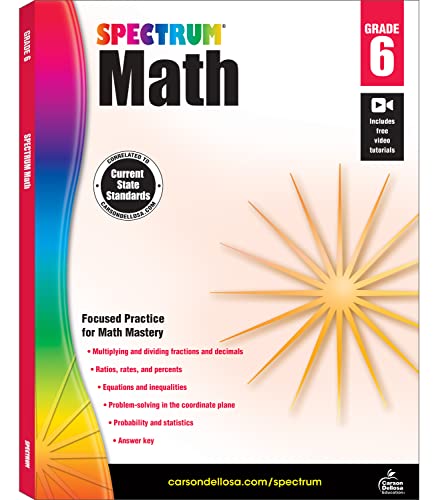
The Spectrum 6th Grade Math Workbooks provide a comprehensive suite of activities designed to align with current state standards. The program introduces topics in progressively challenging steps, which helps students build confidence as they master fractions, decimals, and basic algebraic concepts. The workbook format supports independent practice and self-checks, enabling learners to identify and address gaps between lessons. It also includes pretests, post-tests, mid-tests, and a final test to measure cumulative progress. Teachers and homeschoolers can use the structured sequence to pace instruction and monitor growth over a school year.
Key strengths include clear, student-friendly explanations and a broad range of problems that reinforce procedural fluency while integrating real-world applications. Because the content spans foundational arithmetic to more advanced topics like probability and statistics, it can complement both classroom instruction and at-home practice. For families seeking a structured, standards-aligned workbook with built-in assessments, this title offers a balanced mix of guided learning and independent practice.
Spectrum Grades 6-8 Algebra 1 Workbook
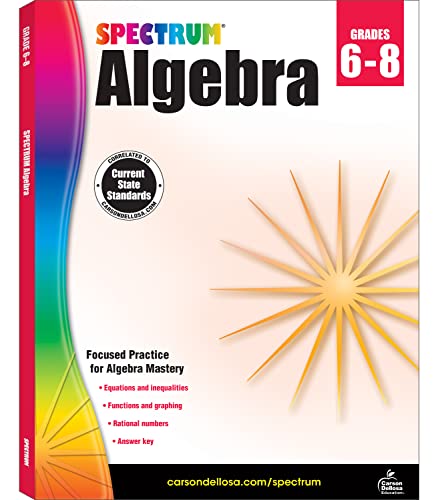
This Spectrum Algebra 1 Workbook serves as a bridge between basic arithmetic and algebraic thinking. Aimed at learners aged 11 to 14, it covers algebraic equations, rational numbers, functions, graphing, and proportions. The workbook format typically includes concise explanations followed by guided practice, making it suitable as a supplement to classroom lessons or as a homeschool resource. Activities are designed to strengthen problem-solving and analytical skills that students apply to real-world contexts, helping them see how algebra underpins many everyday situations.
What stands out here is its focus on making algebra approachable for younger students, with step-by-step instructions and clearly labeled examples. It can be particularly helpful for students who need to see multiple representations of a concept (symbolic, numeric, and graphical) to solidify understanding. This title is a practical choice for families seeking to extend math skills beyond sixth grade while maintaining alignment with typical middle school standards.
Shell Education 180 Days of Problem Solving for Sixth Grade

Shell Education’s 180 Days of Problem Solving offers a yearlong, daily practice approach focused on critical thinking and reasoning. This program emphasizes problem-solving strategies that apply across math domains, encouraging students to analyze word problems, identify patterns, and formulate strategies. The consistent daily format helps students develop a habit of deliberate practice, which can improve accuracy and speed over time. While it is less about teaching new content and more about applying and organizing thinking, it serves as a valuable reinforcement tool for mid-year gaps or for homeschooling schedules that require steady, manageable workloads.
Designed for classroom use but adaptable for home learning, the workbook can complement core math curricula by adding a daily drill that targets problem-solving fluency. Teachers and parents can use the daily tasks to track progress, observe common error patterns, and tailor guidance to students’ unique needs. If your goal is to cultivate a strategic, reasoning-oriented mindset in math, this title provides a steady, practical framework.
Horizons 6th Grade Math Student Book 1

The Horizons 6th Grade Math Student Book 1 provides a parent-led, Christian-based curriculum with a spiral learning approach. By revisiting key concepts through a rotating sequence, students can build mastery over time and reinforce prior learning while integrating new topics. This format is well-suited for families seeking a faith-aligned educational resource that emphasizes routine and structure. The spiral method supports long-term retention by revisiting core ideas such as fractions, decimals, and basic algebra in varied contexts.
Because the program is designed for parent involvement, it can be advantageous for homeschoolers or families who prefer a guided approach. It may require more active teacher support compared to fully self-guided workbooks, but it offers consistent pacing and a clear progression. If a faith-based, parent-driven curriculum matches a learner’s needs, Horizons provides an organized framework that balances instruction with practice.
Buying Guide: Key Purchase Considerations
- Curriculum alignment: Ensure the book aligns with your state standards or your school’s curriculum framework. Look for explicit references to standards, unit outlines, and progression between grade levels.
- Learning style compatibility: Consider whether the student benefits from workbook-style practice, guided lessons, daily problem-solving, or a combination. Some titles emphasize quick drills, others prioritize conceptual understanding and reasoning.
- Assessment features: Chapters, pretests, post-tests, or end-of-unit assessments can help measure growth. Choose resources that provide built-in progress checks if you want ongoing feedback without separate testing materials.
- Support for parents and teachers: For homeschoolers or caregivers, look for clear instructions, answer keys, and solutions that explain the steps. Some programs are more teacher-guided, which may require more involvement from a parent coach.
- Flexibility and pacing: If your schedule varies, opt for materials that offer modular units or a flexible pace. Daily practice books can be excellent for consistent routine, while broader workbooks support deeper exploration.
- Topic diversity: Ensure the selected titles cover a broad range of topics—fractions, decimals, ratio, algebra basics, probability, and statistics—to provide a well-rounded foundation.
- Age and grade appropriateness: Confirm the book’s intended age range and grade level matches your learner’s current stage. Some algebra-focused titles may be suitable for late 6th graders, while others target early 7th grade.
- Format and usability: Consider font size, layout, and the clarity of worked examples. A well-structured workbook with clear steps can reduce frustration and improve independent work.
- Additional resources: Check whether the book includes online resources, teacher guides, or digital practice to supplement learning and keep content engaging.